How to Compare Custom Closet Quotes Without Overpaying
By Perry BirmanFounder, American Built-In Closets · Custom Closet Designer, Storage Solutions Specialist & Space Optimization Expert|Originally published: August 2026
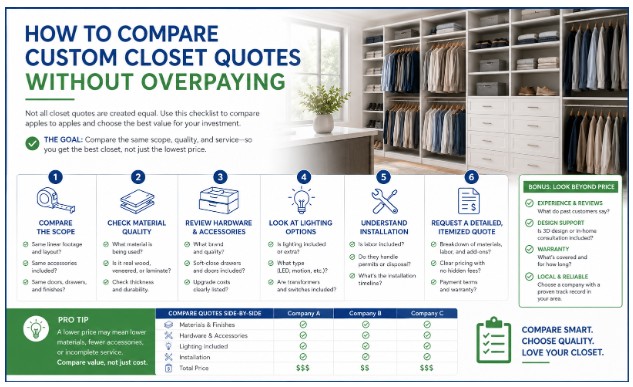
Comparing custom closet quotes requires evaluating five line items side by side: material grade, measured linear footage, hardware specification, warranty terms, and payment schedule. A lower total price without matching detail on each line item usually signals a lighter-grade build, not a better deal.
South Florida homeowners who request a free quote from more than one provider can use this checklist to compare bids accurately, rather than relying on the bottom-line number alone.
This distinction matters because a vague estimate cannot be measured against a competing bid using the same standard.
Key Takeaways
A quote missing measured linear footage, named material grade, or written warranty terms cannot be compared fairly against a competing bid, regardless of price.
Wide price spreads between quotes for the same space usually trace back to material tier, hardware grade, or installation method — not markup alone.
Warranty length and coverage scope vary significantly between providers and directly affect the long-term cost of ownership.
The lowest quote is not automatically the best value once material grade, hardware quality, and warranty coverage are matched line by line.
South Florida homeowners deserve real numbers, not guesswork — American Built-In Closets provides itemized, in-home estimates. Request a free quote today.
What Should Be Included in Every Custom Closet Quote?
A complete quote lists five elements: the named material and brand, the measured linear footage, the hardware specification, the installation timeline, and the written warranty terms. Omitting any one of these turns a quote into a rough guess rather than a binding estimate.
Perry Birman, Founder of American Built-In Closets, a custom closet design and manufacturing company headquartered in Lauderdale Lakes, Florida, treats a missing line item as the first red flag in any bid.
A quote referencing only a cost factor range without a specific material name cannot be compared against a competing bid that names an exact product.
An itemized quote is a written estimate that lists individual costs for materials, hardware, labor, and fees separately, rather than presenting a single lump-sum total — and it is the only format that enables a fair comparison.
Line Item
What to Look For
Red Flag If Missing or Vague
Material grade
Named product (e.g., high-density melamine)
“Wood-look laminate” with no grade specified
Linear footage
Exact measured footage from in-home visit
Estimated footage without a site visit
Hardware spec
Named brand, soft-close rating, cycle count
“Standard hardware” with no brand or rating
Installation timeline
Specific start and completion dates
Vague “a few weeks” with no written date
Warranty terms
Written coverage length and scope
Verbal promise with nothing in the contract
How Do You Compare Quotes With Different Material Grades?
Matching material grade before comparing price prevents a homeowner from mistaking a lighter-grade bid for a lower-cost version of the same closet. Standard laminate, high-density melamine, and real wood veneer carry different per-linear-foot rates, so two quotes naming different materials are not directly comparable at face value.
Reviewing closet materials side by side before requesting quotes helps a homeowner recognize when a lower bid reflects a lower material tier rather than a better price on the same build.
Running the same footage through a cost calculator worksheet first establishes what a fair price range should look like before quotes arrive, so a homeowner can spot an outlier bid immediately.
If you’re ready to get
started, call us now!
Why Do Custom Closet Quotes Vary So Widely for the Same Space?
Three variables account for nearly all price gaps between quotes for identical square footage: material tier, hardware grade, and installation method. A $2,000 spread between two bids for the same walk-in closet almost always traces back to one of these three factors rather than arbitrary markup.
Checking Broward County pricing history against a specific quote helps confirm whether a bid falls within a normal range for the stated material and footage.
A quote priced 40% below every competing bid for identical specifications warrants direct questions about which corners the lower price assumes.
Reviewing a budget worksheet before shopping for quotes also clarifies which upgrades are worth paying for, so a wide spread between bids becomes easier to interpret rather than simply alarming.
What Red Flags Signal an Underpriced or Padded Quote?
An underpriced quote typically excludes installation, omits hardware detail, or requires full payment upfront before any work begins. A padded quote typically bundles vague “premium” language without naming a specific product, brand, or measurable spec.
The Florida Attorney General’s consumer protection guidance recommends obtaining at least three written, itemized estimates before hiring any home improvement contractor, specifically to surface these gaps through direct comparison.
The Federal Trade Commission’s guidance on hiring contractors further warns that a contractor unwilling to provide a detailed written estimate, including materials and a completion date, is a red flag regardless of the quoted price.
High-pressure tactics — same-day discounts, leftover-materials claims, or full payment demanded before work starts — appear consistently across underpriced bids and deserve the same scrutiny as an unusually low number.
How Do Warranty Terms Affect the True Cost of a Quote?
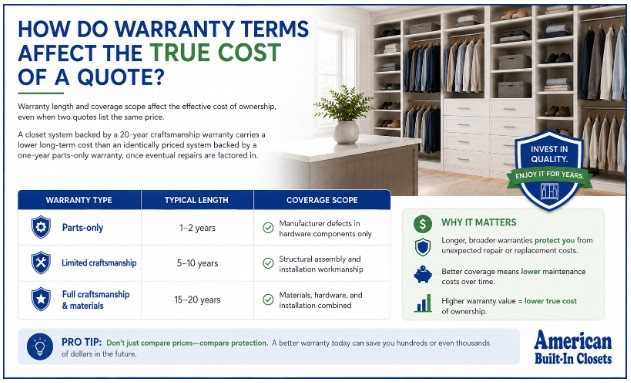
Warranty length and coverage scope affect the effective cost of ownership, even when two quotes list the same price. A closet system backed by a 20-year craftsmanship warranty carries a lower long-term cost than an identically priced system backed by a one-year parts-only warranty, once eventual repairs are factored in.
Warranty Type
Typical Length
Coverage Scope
Parts-only
1–2 years
Manufacturer defects in hardware components only
Limited craftsmanship
5–10 years
Structural assembly and installation workmanship
Full craftsmanship & materials
15–20 years
Materials, hardware, and installation combined
Reviewing custom closet FAQs before signing clarifies what a specific provider’s warranty actually covers, since “warranty included” without a stated length or scope offers no real protection.
A DIY number is only a starting point — Perry Birman’s team turns every estimate into an exact, itemized quote during a design consultation.
If you’re ready to get
started, call us now!
Should the Lowest Quote Always Win?
The lowest quote should win only if material grade, hardware quality, and warranty coverage are matched line by line against every competing bid. A lower price attached to a lighter material tier or a shorter warranty is not automatically the better value — it is a different product at a different price point.
Comparing custom vs. modular systems illustrates this principle clearly: a modular kit will almost always underprice a fully custom system, but the two are not interchangeable once installation precision and long-term durability are considered.
Custom closets also increase home value in South Florida’s resale market, a return the lowest-tier option rarely delivers to the same degree.
What Questions Should You Ask Before Signing a Custom Closet Contract?
Five questions clarify a quote before signing: What exact material and brand is specified? Was linear footage measured on-site or estimated? What hardware brand and cycle rating is included? What is the written warranty length and scope? What is the installation start and completion date?
Florida homeowners can verify any contractor’s license status directly through the Florida DBPR licensee search before signing.
Under Florida Statute 489.128, a contract entered into with an unlicensed contractor is unenforceable by that contractor, removing a homeowner’s legal recourse if a dispute arises later.
Reviewing installation preparation steps beforehand also confirms that the timeline referenced in the contract is realistic.
Every month spent comparing vague bids costs South Florida homeowners real clarity and real money — contact American Built-In Closets for an itemized quote.
Contact Us Today For An Appointment
Frequently Asked Questions
What are five things every custom closet quote should include?
Every complete quote should name the exact material and brand, measured linear footage from an in-home visit, hardware specification with brand and rating, a written installation timeline, and specific warranty terms. Missing any one of these prevents a fair comparison against competing bids.
Why do two quotes for the same closet vary by thousands of dollars?
Price spreads usually trace back to material tier, hardware grade, or installation method rather than arbitrary markup. A quote using standard laminate will always underprice one specifying high-density melamine or real wood veneer for identical linear footage and closet type.
Is a verbal estimate enough to compare against a written quote?
A verbal estimate cannot be fairly compared against a written, itemized quote because it lacks the specific material, footage, and warranty detail needed for comparison. The Florida Attorney General recommends obtaining written estimates from multiple providers before hiring any contractor.
What warranty length should a custom closet quote include?
Full craftsmanship and materials warranties typically run 15–20 years, while limited craftsmanship warranties run 5–10 years and parts-only warranties run 1–2 years. Shorter warranty terms increase the effective long-term cost of an otherwise identically priced quote over the system’s lifespan.
How can a homeowner tell if a low quote is underpriced?
An underpriced quote typically excludes installation costs, omits specific hardware details, or requires full payment before work begins. Comparing the bid against a cost calculator worksheet for the same material tier and footage quickly reveals whether the number falls outside a normal range.
Should installation always be itemized separately from materials?
Installation should always appear as its own line item, typically $500–$2,500 in Broward County, separate from material and hardware costs. A quote that bundles installation into one lump sum makes it impossible to compare labor pricing against a competing bid.
Is it safe to hire a contractor without verifying their license?
Florida homeowners should verify contractor licensing through the state DBPR licensee search before signing any contract. Under Florida Statute 489.128, contracts with unlicensed contractors are unenforceable by that contractor, leaving a homeowner without legal recourse if a dispute arises later.
How many quotes should a homeowner get before deciding?
The Florida Attorney General’s Office recommends obtaining at least three written, itemized estimates before hiring a home improvement contractor. Comparing three bids surfaces outliers on both ends and clarifies which specific line items explain any price differences between them line by line.
Does a higher quote always mean better quality?
A higher quote does not automatically mean better quality — it must be verified against the same checklist: named material grade, measured footage, hardware specification, and warranty terms. Some higher bids reflect franchise overhead rather than superior materials or on-the-job craftsmanship.
Can payment schedule terms reveal a problematic contractor?
A contractor demanding full payment upfront before any work begins is a recognized warning sign under FTC consumer guidance. A legitimate payment schedule ties installments to project milestones, protecting the homeowner if the contractor fails to complete the work as agreed.
Founder, American Built-In Closets · Custom Closet Designer · Storage Solutions Specialist · Space Optimization Expert
Perry Birman is the founder of American Built-In Closets, a South Florida custom closet and storage company he established in 1996. With nearly three decades of experience in custom storage design, furniture manufacturing, and residential space optimization, Perry has helped homeowners throughout Miami-Dade, Broward, and Palm Beach counties create functional, customized organization systems tailored to their homes and lifestyles.
Drawing on a hands-on background in furniture manufacturing and production, Perry has extensive expertise in materials selection, fabrication processes, structural design, cabinetry construction, and custom-built storage systems. He has overseen the design, manufacturing, and installation of thousands of custom closets, garage storage systems, home offices, pantries, wall units, and built-in organization solutions throughout South Florida.
As founder of American Built-In Closets, Perry oversees design standards, manufacturing operations, product quality, and project development. His work focuses on maximizing usable space while maintaining durability, craftsmanship, functionality, and long-term value for homeowners.
Perry regularly shares insights on custom closet design, home organization, space optimization, built-in storage solutions, cabinetry construction, and residential storage trends based on nearly 30 years of real-world experience serving South Florida homeowners.
Credentials Snapshot
Founder, American Built-In Closets (1996–Present)
Nearly 30 Years of Custom Storage & Closet Design Experience
Expertise in Furniture Manufacturing & Cabinet Construction
Specialization: Custom Closets, Garage Storage, Home Offices, Pantries & Built-In Organization Systems
Service Area: Miami-Dade, Broward & Palm Beach Counties, Florida