The Most Common Closet Upgrades Homeowners Wish They Had Added Before Installation
By Perry BirmanFounder, American Built-In Closets · Custom Closet Designer, Storage Solutions Specialist & Space Optimization Expert|Originally published: June 2026
Seven closet upgrades consistently appear on homeowners’ wish lists after installation: pull-out drawers, integrated LED lighting, a built-in hamper, adjustable shelving, dedicated shoe storage, a valet rod, and jewelry trays.
Each one costs a fraction of the total project when included in the original design — but retrofitting any of them after installation means disassembling finished components, remanufacturing panels, and paying a second round of labor.
American Built-In Closets builds every upgrade into the 3D design consultation so nothing gets missed before manufacturing begins.
Key Takeaways
Pull-out drawers, LED lighting, and adjustable shelving are the three upgrades homeowners request most often after installation — and the three easiest to include during initial design.
Retrofitting a single feature after installation typically costs two to three times as much as including it in the original build, because finished panels must be disassembled and recut.
A thorough design consultation that maps real wardrobe habits — not generic templates — prevents upgrade regret before the first component is manufactured.
Your closet should include every feature you need from day one. Schedule a free design consultation at 954-748-0800 or request a free quote.
1. Pull-Out Drawers Instead of All-Shelf Layouts
Shelves store folded items visually, but drawers store them functionally. Homeowners who receive an all-shelf closet quickly discover that folded stacks topple, smaller items disappear behind taller ones, and reaching items at the back of a deep shelf means dismantling the pile in front.
Full-extension, ball-bearing drawer glides let the entire drawer open without tipping, so you can see and reach every item in a single motion. Soft-close mechanisms prevent slamming and keep cabinet joints aligned for years of daily use.
We recommend a minimum of three to four drawers per closet section — dedicated to socks, undergarments, folded casual wear, and accessories — because each category needs its own space to stay organized.
Adding drawers during initial design costs $50–$100 per unit installed. Retrofitting drawers into a finished system requires removing shelving, remanufacturing panels, and reinstalling hardware — a process that typically costs two to three times the original per-unit price.
2. Integrated LED Lighting With Motion Sensors
Builder-grade closets across Broward County ship with no dedicated lighting. Homeowners rely on bedroom light spilling through the doorway and quickly realize they cannot distinguish navy from black, charcoal from brown, or locate accessories in dark corners.
Integrated LED closet lighting solves visibility at every shelf level. Under-shelf strips illuminate folded stacks. Recessed ceiling LEDs brighten the full space. Motion sensors activate lights the moment the door opens and shut off automatically, so you find what you need at first glance without fumbling for a switch.
LED strips last 25,000–50,000 hours and consume minimal electricity, according to the U.S. Department of Energy. Wiring LED strips during initial construction is straightforward.
Running wiring through finished closet panels after installation requires cutting access points, patching surfaces, and coordinating with an electrician — turning a $300–$800 upgrade into a significantly larger project.
If you’re ready to get
started, call us now!
3. A Built-In Pull-Out Hamper
Without a designated hamper, dirty laundry lands on the closet floor, on chairs, or in a freestanding basket that takes up floor space and blocks access to lower shelving. A built-in pull-out hamper mounts inside the closet system, slides out on the same full-extension glides used for drawers, and keeps laundry contained without sacrificing walkable space.
Dual-compartment hampers allow sorting lights and darks at the point of undressing, so laundry day starts with pre-sorted loads instead of a pile that needs separating. The hamper slides back into the cabinet face when not in use, maintaining the closet’s clean visual line.
Including a hamper during initial design costs $75–$150 for the unit and hardware. Retrofitting one into a finished closet often requires removing an existing shelf or drawer section and reconfiguring the surrounding cabinetry.
Stop guessing about what your closet needs — we walk through every upgrade option during your free 3D design consultation. Request yours today.
4. Adjustable Shelving Instead of Fixed
Fixed shelves permanently lock homeowners into one configuration. A shelf installed at 14 inches for folded sweaters cannot accommodate tall boots, handbags, or storage bins without leaving wasted vertical space above or below the items stored.
Adjustable shelving uses pin-and-bracket systems that allow shelf height to change in 1-inch increments without tools. Homeowners can reconfigure seasonal storage, adapt to a growing child’s wardrobe, or shift from folded clothing to display shelving as needs evolve — without replacing a single component.
The cost difference between fixed and adjustable shelving during initial manufacturing is negligible. The cost of converting fixed shelves to adjustable after installation requires new side panels with pin holes, new shelf units cut to fit, and a second installation visit.
5. Dedicated Shoe Storage With Angled Trays
Shoes piled on the closet floor create the single most common source of daily clutter that homeowners report. Flat shelves help, but shoes slide, stack unevenly, and hide behind each other on deep shelves.
Angled pull-out shoe trays display each pair at a visible angle, so you can identify shoes without moving other pairs. Ventilated trays also promote air circulation — a practical benefit in Florida’s humid climate, where enclosed shoe storage can trap moisture and cause odor.
We design shoe sections based on actual pair count: a homeowner with 15 pairs needs a different configuration than one with 40 pairs, and the design consultation captures that number before manufacturing starts.
6. A Valet Rod for Next-Day Outfit Prep
A valet rod is a retractable pull-out rod mounted at chest height that holds the next day’s outfit, freshly steamed garments, or dry-cleaning returns. The rod extends when needed and slides back flush with the cabinet face when not in use.
Homeowners who skip valet rods end up draping tomorrow’s outfit over chairs, doorknobs, or the bed — surfaces that wrinkle clothing and create visual clutter outside the closet.
Including a valet rod during design adds $25–$50 to the project. Retrofitting one into a finished closet system requires drilling into the cabinetry, which risks damaging the melamine finish.
If you’re ready to get
started, call us now!
7. Jewelry and Accessory Trays
Watches, rings, bracelets, cufflinks, and sunglasses need shallow, compartmentalized storage. Without dedicated trays, small items scatter across shelf surfaces, fall behind drawers, or end up in kitchen junk drawers where they don’t belong.
Velvet-lined accessory trays with divided compartments keep each item visible and separated. Pull-out trays mounted at waist height put accessories at eye level during morning routines, so you select what you need without opening multiple containers or searching through bags.
These trays add $30–$75 per unit during initial build. The NAHB’s What Home Buyers Really Want research ranks organized, personalized storage features among the most desired closet elements — making accessory trays a small investment with outsized impact on daily function and resale perception.
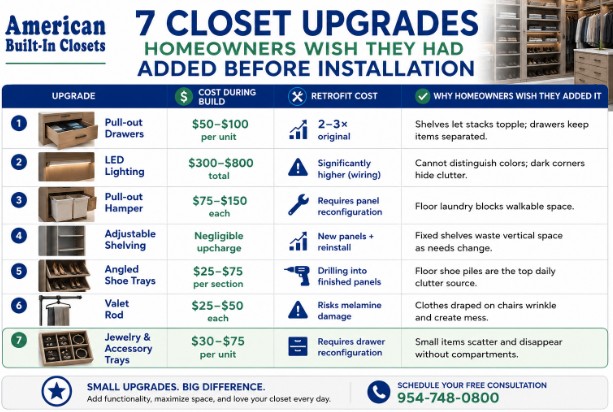
Upgrade
Cost During Build
Retrofit Cost
Why Homeowners Wish They Added It
Pull-out drawers
$50–$100/unit
2–3× original
Shelves let stacks topple; drawers keep items separated
LED lighting
$300–$800 total
Significantly higher (wiring)
Cannot distinguish colors; dark corners hide clutter
Pull-out hamper
$75–$150
Requires panel reconfiguration
Floor laundry blocks walkable space
Adjustable shelving
Negligible upcharge
New panels + reinstall
Fixed shelves waste vertical space as needs change
Angled shoe trays
$25–$75/section
Drilling into finished panels
Floor shoe piles are the top daily clutter source
Valet rod
$25–$50
Risks of melamine damage
Clothes draped on chairs wrinkle and create a mess
Jewelry/accessory trays
$30–$75/unit
Requires drawer reconfiguration
Small items scatter and disappear without compartments
Contact Us Today For An Appointment
Frequently Asked Questions
What is the closet upgrade homeowners regret skipping most?
Pull-out drawers are the upgrade homeowners request most frequently after installation. All-shelf layouts let folded stacks topple and hide smaller items, while full-extension drawers keep every category separated and visible. Adding drawers during the initial build costs a fraction of what retrofitting them later would.
Can I add LED lighting to an existing custom closet?
LED lighting can be added after installation, but the process requires cutting access points for wiring, coordinating with an electrician, and patching finished melamine surfaces. Including lighting during the original design and build avoids surface damage and keeps costs substantially lower.
How much does it cost to retrofit a closet upgrade after installation?
Retrofitting a single feature after installation typically costs two to three times as much as including the same upgrade during the original build. The added expense comes from disassembling finished panels, remanufacturing components to accommodate the new feature, and paying for a second installation visit.
Why is adjustable shelving better than fixed shelving?
Adjustable shelving uses pin-and-bracket systems that allow height changes in one-inch increments without tools. Fixed shelving permanently locks homeowners into one configuration, wasting vertical space as stored items change size or category over time. The upfront cost difference is negligible.
What size shoe storage section do I need?
Shoe storage should match the homeowner’s actual pair count. A 15-pair wardrobe needs a different configuration than a 40-pair collection. Our design consultation captures exact pair counts, heel heights, and boot dimensions before manufacturing begins, so every shoe has a designated space.
Do valet rods actually get used daily?
Homeowners who install valet rods report using them daily for next-day outfit prep, steaming, and dry-cleaning staging. The rod extends when needed and retracts flush into the cabinet face when not in use, so the feature takes zero permanent space and eliminates clothes draped over bedroom furniture.
How do I avoid missing upgrades during the design phase?
A thorough design consultation that inventories your full wardrobe — hanging garments, folded items, shoes, accessories, seasonal gear, and laundry habits — prevents upgrade regret. Our 3D renderings include every feature before manufacturing, so you approve the complete system visually before a single panel is cut.
Are closet upgrades worth the investment for resale value?
Organized closets with pull-out drawers, integrated lighting, and dedicated accessory storage signal quality to buyers and appraisers. Custom closet features consistently appear on lists of most-desired home upgrades, making well-planned storage a resale advantage in competitive South Florida markets.
Every feature you skip during design costs two to three times more to add later. Call Perry Birman and the team at American Built-In Closets at 954-748-0800 for a free in-home consultation where every upgrade is built into your 3D rendering before manufacturing. Request your free quote today.
Founder, American Built-In Closets · Custom Closet Designer · Storage Solutions Specialist · Space Optimization Expert
Perry Birman is the founder of American Built-In Closets, a South Florida custom closet and storage company he established in 1996. With nearly three decades of experience in custom storage design, furniture manufacturing, and residential space optimization, Perry has helped homeowners throughout Miami-Dade, Broward, and Palm Beach counties create functional, customized organization systems tailored to their homes and lifestyles.
Drawing on a hands-on background in furniture manufacturing and production, Perry has extensive expertise in materials selection, fabrication processes, structural design, cabinetry construction, and custom-built storage systems. He has overseen the design, manufacturing, and installation of thousands of custom closets, garage storage systems, home offices, pantries, wall units, and built-in organization solutions throughout South Florida.
As founder of American Built-In Closets, Perry oversees design standards, manufacturing operations, product quality, and project development. His work focuses on maximizing usable space while maintaining durability, craftsmanship, functionality, and long-term value for homeowners.
Perry regularly shares insights on custom closet design, home organization, space optimization, built-in storage solutions, cabinetry construction, and residential storage trends based on nearly 30 years of real-world experience serving South Florida homeowners.
Credentials Snapshot
Founder, American Built-In Closets (1996–Present)
Nearly 30 Years of Custom Storage & Closet Design Experience
Expertise in Furniture Manufacturing & Cabinet Construction
Specialization: Custom Closets, Garage Storage, Home Offices, Pantries & Built-In Organization Systems
Service Area: Miami-Dade, Broward & Palm Beach Counties, Florida