How Custom Closet Needs Change After 60: What South Florida Retirees Actually Ask For
By Perry BirmanFounder, American Built-In Closets · Custom Closet Designer, Storage Solutions Specialist & Space Optimization Expert|Originally published: July 2026 | Updated: August 2026
Retirement changes what a closet needs to hold, how high it needs to reach, and how safely it needs to function every morning. Perry Birman, Founder of American Built-In Closets, has designed custom closet systems for retirees across Broward and Palm Beach County for nearly 30 years.
The requests follow a clear pattern — lower rods, waist-height drawers, integrated seating, brighter lighting, and dedicated zones for the active, travel-heavy lifestyle that defines South Florida retirement. These are not limitations. They are design upgrades for a new chapter.
Key Takeaways
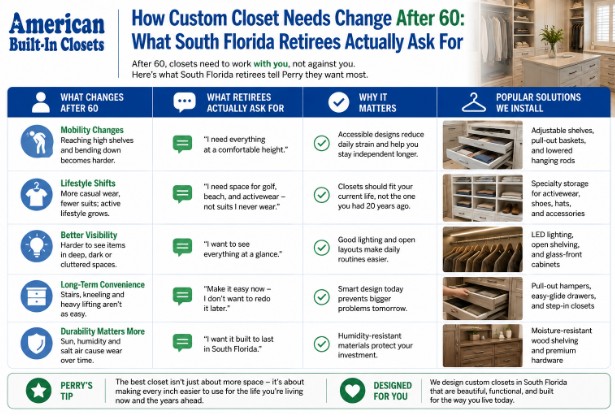
South Florida retirees consistently request lower hanging rods (48–54 inches), pull-out drawers at waist height, and LED closet lighting — accessibility features that reduce reaching, bending, and fall risk.
Downsizing from a 4-bedroom home to a 2-bedroom condo requires consolidating two full wardrobes into one closet system designed for volume without clutter.
Dedicated storage zones for golf gear, travel wardrobes, mobility aids, and medical devices rank among the most common custom requests Perry Birman receives from clients over 60.
American Built-In Closets designs every retiree closet system at its Sunrise, FL, manufacturing facility around lifestyle evolution — not physical decline.
Your closet should keep pace with your life, not slow it down. American Built-In Closets designs custom storage for South Florida retirees who want accessibility, organization, and style in the same system — schedule your free consultation today.
What Closet Features Do Older Adults Actually Need?
The closet features older adults need are not specialized medical accommodations — they are practical design adjustments that eliminate unnecessary reaching, bending, and visual strain during daily routines.
Perry Birman’s most requested features from clients over 60 across Broward and Palm Beach County fall into five categories.
Feature
What It Solves
Standard Spec (American Built-In Closets)
Lower hanging rods
Eliminates overhead reaching for daily garments
Primary rod at 48–54 inches (vs. standard 66–72 inches)
Pull-out drawers at waist height
Removes bending to floor-level storage
Drawer bank centered at 30–42 inches; full-extension, soft-close glides
Integrated LED lighting
Compensates for reduced contrast sensitivity in aging eyes
Motion-activated LED strips under shelves and inside drawer interiors
Built-in seating bench
Provides a stable seated dressing for shoes, socks, and pants
Accesses upper storage without step stools or reaching
Spring-loaded mechanism lowers rod 12–18 inches with one hand
These five features form the foundation of most retiree closet designs Perry Birman produces. Each one addresses a functional priority — not a disability.
A 65-year-old golfer who plays three times a week does not need a medical-grade closet. That golfer needs a closet that puts everyday clothes at arm’s reach and stores golf shoes, rain gear, and a travel bag without stacking bins on the floor.
If you’re ready to get
started, call us now!
Best Closet Design for Seniors — Accessibility Without Compromise
The best closet design for seniors prioritizes three principles that Perry Birman applies to every retiree project: everything visible, everything reachable, and nothing on the floor.
Everything visible means replacing solid drawer fronts with glass-panel inserts or open shelving in the primary dressing zone so clothing is identifiable without opening and closing compartments.
LED lighting with color temperatures between 4000K and 5000K provides the brightness and contrast that aging eyes require to distinguish navy from black, gray from charcoal.
The National Institute on Aging identifies inadequate lighting as a primary fall risk factor in home environments — and closets rank among the darkest rooms in most South Florida homes.
Everything reachable means positioning 80% of daily-use garments between 30 and 60 inches from the floor — the natural reach zone for a standing adult without overhead extension or deep bending.
Pull-down rods bring seasonal and infrequently worn items within reach without step stools, which the U.S. Consumer Product Safety Commission identifies as a leading source of fall injuries among adults over 65.
Nothing on the floor means eliminating loose shoes, bins, and bags from the closet floor surface. Elevated shoe racks (at least 4 inches off the floor), mounted hamper pull-outs, and wall-anchored built-in storage prevent the trip hazards posed by unsecured floor items — particularly in low-light closet interiors.
Custom Closet for Retirees Downsizing in South Florida
Downsizing from a 4-bedroom Coral Springs home to a 2-bedroom Pompano Beach condo is one of the most common transitions Perry Birman navigates with retiree clients. The closet challenge is specific: two full wardrobes that previously occupied separate his-and-hers closets must now consolidate into a single shared system — often a reach-in closet with 6 to 8 linear feet of wall space.
Perry Birman conducts a wardrobe audit before any design work begins for every downsizing consultation.
The audit identifies how many linear feet of hanging space each person actually uses daily, compared with how much space seasonal, formal, and sentimental garments occupy.
Most retirees discover that 40–60% of their pre-retirement wardrobe — business suits, office shoes, cold-weather coats rarely worn in South Florida — can be archived, donated, or stored in a secondary location.
The custom closet system that follows the audit maximizes the remaining wardrobe’s accessibility. Double-hang sections for everyday casual wear (the dominant wardrobe category for South Florida retirees) reclaim vertical space.
Dedicated drawer banks for folded items replace the dressers that no longer fit in a smaller bedroom. Shared closets get clearly defined his-and-hers zones with visual dividers so both wardrobes stay organized without overlap.
Dedicated Storage Zones South Florida Retirees Request Most
Perry Birman’s retiree clients in Broward and Palm Beach County live actively — they golf three to four days a week, travel domestically and internationally, host grandchildren, and manage ongoing health needs.
Their closet systems need dedicated zones that standard builder-grade closets were never designed to accommodate.
Golf and sports gear zone. South Florida retirees store golf shoes, rain jackets, visors, gloves, and rangefinders alongside their daily wardrobe. Perry Birman designs ventilated pull-out shoe bins that need airflow after rounds in Florida heat, wall-mounted hooks for hats and bags, and a dedicated shelf section for accessories that would otherwise scatter across the closet floor.
Travel wardrobe zone. Frequent travelers need a designated section for travel-specific items — packing cubes, compression bags, TSA-approved toiletry kits, passport holders, and a capsule wardrobe of versatile garments that pack without wrinkling. A pull-out valet rod in this zone allows pre-trip outfit assembly without disrupting the main wardrobe.
Medical device and mobility aid zone. CPAP machines, blood pressure monitors, hearing aid cases, and prescription organizers require accessible, consistent storage locations — not nightstand clutter.
Perry Birman integrates a dedicated drawer or shelf section with a built-in electrical outlet for device charging into many retiree closet designs. Clients who use walkers or canes get a wall-mounted hook or recessed niche inside the closet so the device stays upright, accessible, and out of the walking path.
Grandchild-ready zone. Retirees who host grandchildren regularly request a lower shelf section or small drawer bank stocked with children’s essentials — a change of clothes, swim gear, a toy bin. This zone sits at the perimeter of the closet and stays out of the primary dressing flow.
If you’re ready to get
started, call us now!
Aging in Place Closet Modifications — What Actually Prevents Falls
The Centers for Disease Control and Prevention reports that one in four adults aged 65 and older falls each year, and that most falls occur in the home. Closets contribute to fall risk through three specific hazards: poor lighting, floor-level clutter, and unstable furniture used for balance.
Perry Birman’s aging-in-place closet modifications address all three hazards structurally — not with aftermarket accessories bolted onto failing systems.
Floor-to-ceiling built-in systems anchored to wall studs provide stable surfaces that support body weight if a person reaches for balance.
Freestanding modular units, wire shelving, and standalone dressers cannot provide this stability and may topple under lateral force — a distinction the National Association of Home Builders’ CAPS program emphasizes in its aging-in-place design guidelines.
Motion-activated LED lighting eliminates the need to locate a switch or pull chain in a dark closet.
Full-extension, soft-close drawers prevent finger-pinch injuries and reduce the force required to open and close storage compartments. Lever-style hardware on closet doors (replacing round knobs) accommodates reduced grip strength without requiring assistive devices.
Every modification Perry Birman installs serves a dual purpose — it makes the closet safer today and maintains the home’s resale value for tomorrow. Custom built-in closets with accessibility features appeal to the fastest-growing buyer demographic in South Florida’s real estate market: adults over 55.
How American Built-In Closets Designs for South Florida Retirees
Every retiree closet project at American Built-In Closets begins with a conversation about lifestyle — not limitations. Perry Birman or a senior designer conducts a free in-home consultation that covers daily routines, wardrobe volume, mobility considerations, hobbies, travel frequency, and any medical device storage needs.
The design team then produces a 3D rendering showing rod heights, drawer placement, lighting positions, and specialty zones — all configured for the client’s actual reach range and daily flow.
Manufacturing takes place at the company’s Sunrise, FL facility, using MR-grade particleboard with thermally fused melamine on both faces, PVC edge banding on all four edges, and nickel-plated soft-close hardware throughout the system.
Every component is custom-built to the room’s exact dimensions and the client’s specific ergonomic requirements — eliminating the gaps, misaligned rod heights, and unstable mounting that generic systems produce.
The 20-year warranty covers shelving integrity, hardware function, and finish durability.
At 30–40% below major franchise competitors, American Built-In Closets delivers accessibility-focused design at a price point that fits retirement budgets — backed by 121+ five-star Google reviews from homeowners in Broward and Palm Beach counties.
Contact Us Today For An Appointment
Frequently Asked Questions
What is the best closet design for seniors?
The best closet design for seniors places 80% of daily garments between 30 and 60 inches from the floor, uses motion-activated LED lighting, incorporates pull-out drawers at waist height with full-extension soft-close glides, and anchors all storage components to wall studs for stability during balance recovery.
How do I organize a closet for elderly parents?
Start with a wardrobe audit to remove items no longer worn, then install lower hanging rods at 48–54 inches, replace floor-level storage with elevated shoe racks and pull-out bins, add motion-activated LED lighting, and ensure all shelving is structurally anchored to wall studs rather than freestanding.
What are aging in place closet modifications?
Aging in place closet modifications include lowering primary hanging rods, installing built-in seating for seated dressing, adding motion-activated lighting, replacing round door knobs with lever handles, mounting all storage into wall studs for grab-point stability, and eliminating floor-level clutter that creates trip hazards.
What closet design works best for people over 60?
Closet design for people over 60 centers on three principles: everything visible through open shelving or glass-panel drawer fronts, everything reachable between 30 and 60 inches from the floor, and nothing loose on the floor. Pull-down rods, integrated seating, and dedicated hobby or medical storage zones complete the system.
What closet features do older adults need?
Older adults need lower hanging rods, waist-height pull-out drawers with soft-close glides, motion-activated LED lighting with 4000–5000K color temperature for accurate garment identification, built-in seating at 18-inch height, and structurally anchored built-in systems that provide stable surfaces for balance support.
How do retirees downsize closet space?
Retirees downsize closet space by conducting a wardrobe audit to separate daily-wear items from seasonal, formal, and sentimental garments. Custom closet systems then maximize the remaining wardrobe space with double-hang sections for casual wear, built-in drawer banks that replace standalone dressers, and upper-shelf seasonal zones.
Are custom closets safe for elderly homeowners?
Custom closets anchored to wall studs provide stable surfaces that support body weight during balance recovery — a safety feature freestanding modular units and wire shelving cannot offer. Motion-activated lighting, soft-close hardware, and elevated floor clearance further reduce the risk of falls and injuries for elderly homeowners.
What is a senior accessible closet?
A senior-accessible closet positions all daily-use garments within a natural reach range, eliminates floor-level trip hazards, uses motion-activated lighting for hands-free visibility, incorporates pull-out drawers and pull-down rods to reduce bending and overhead reaching, and provides structurally stable surfaces throughout.
How much does an accessible closet cost in South Florida?
Custom accessible closet systems from American Built-In Closets typically range from $2,000 to $8,000, depending on closet size, accessibility features, and accessory selections. This pricing is 30–40% below comparable systems from major franchise competitors and includes accessibility-specific design consultation.
Can a custom closet help with downsizing after retirement?
A custom closet designed for post-retirement living consolidates two wardrobes into one shared system with clearly zoned his-and-hers sections, replaces standalone dressers with built-in drawer banks, and uses vertical double-hang configurations to maximize storage capacity in smaller condo floor plans.
Your next chapter deserves a closet designed for how you actually live now. Call Perry Birman at American Built-In Closets at 954-748-0800 for a free in-home design consultation.
Founder, American Built-In Closets · Custom Closet Designer · Storage Solutions Specialist · Space Optimization Expert
Perry Birman is the founder of American Built-In Closets, a South Florida custom closet and storage company he established in 1996. With nearly three decades of experience in custom storage design, furniture manufacturing, and residential space optimization, Perry has helped homeowners throughout Miami-Dade, Broward, and Palm Beach counties create functional, customized organization systems tailored to their homes and lifestyles.
Drawing on a hands-on background in furniture manufacturing and production, Perry has extensive expertise in materials selection, fabrication processes, structural design, cabinetry construction, and custom-built storage systems. He has overseen the design, manufacturing, and installation of thousands of custom closets, garage storage systems, home offices, pantries, wall units, and built-in organization solutions throughout South Florida.
As founder of American Built-In Closets, Perry oversees design standards, manufacturing operations, product quality, and project development. His work focuses on maximizing usable space while maintaining durability, craftsmanship, functionality, and long-term value for homeowners.
Perry regularly shares insights on custom closet design, home organization, space optimization, built-in storage solutions, cabinetry construction, and residential storage trends based on nearly 30 years of real-world experience serving South Florida homeowners.
Credentials Snapshot
Founder, American Built-In Closets (1996–Present)
Nearly 30 Years of Custom Storage & Closet Design Experience
Expertise in Furniture Manufacturing & Cabinet Construction
Specialization: Custom Closets, Garage Storage, Home Offices, Pantries & Built-In Organization Systems
Service Area: Miami-Dade, Broward & Palm Beach Counties, Florida