By Perry BirmanFounder, American Built-In Closets · Custom Closet Designer, Storage Solutions Specialist & Space Optimization Expert|Originally published: August 2026
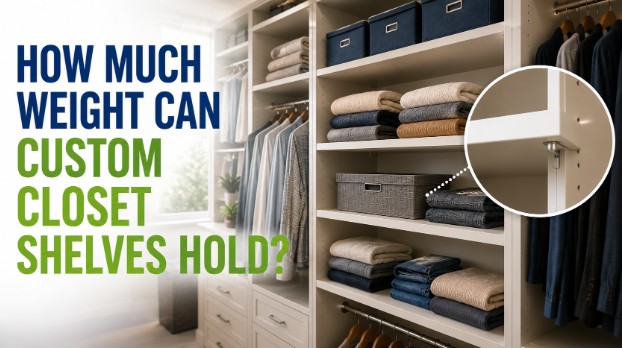
Custom closet shelf weight capacity depends on three factors working together: material type, span length between supports, and anchor connection.
A well-engineered shelf spanning 24–32 inches between supports, built from high-density material, and anchored into a stud or solid block typically holds substantially more than a long, unsupported span in a lower-density material.
Scheduling a free quote lets a designer calculate the right combination for a specific closet layout.
Key Takeaways
Shelf weight capacity depends on material density, the span length between supports, and how securely the support structure is anchored to the wall.
Shorter spans between supports resist sagging better than long, unsupported runs of shelving, regardless of material.
High-density materials hold significantly more weight over the same span than lower-density particleboard or standard laminate.
Federal tip-over safety standards apply to freestanding clothing storage units, such as dressers, but not to wall-anchored built-in closet shelving.
South Florida homeowners deserve shelving engineered for real closet loads, not guesswork — American Built-In Closets calculates support spacing for every design. Request a free quote today.
How Much Weight Can a Custom Closet Shelf Hold?
A shelf’s true weight capacity is not a single number — it varies with the material, the span between supports, and the anchor type securing the support structure to the wall.
A short-span shelf in high-density material anchored into a stud holds meaningfully more than a long-span shelf in low-density material resting on drywall anchors alone.
Perry Birman, Founder of American Built-In Closets, a custom closet design and manufacturing company headquartered in Lauderdale Lakes, Florida, engineers support spacing into every custom closet layout rather than treating shelf strength as a fixed property of the material alone.
A folded-sweater shelf, a shoe shelf, and a stacked-bin shelf each carry different real-world loads, so the support spacing underneath each one should differ accordingly.
If you’re ready to get
started, call us now!
What Determines a Shelf’s Weight Capacity?
Three variables determine a shelf’s actual weight capacity: the material’s inherent rigidity, the unsupported span between brackets or panels, and the strength of the anchor point that holds the support structure to the wall.
Changing any one of these three variables changes how much weight the shelf can carry before it visibly sags.
The U.S. Department of Agriculture’s Forest Products Laboratory documents in its Wood Handbook how wood-based material density and panel thickness affect bending strength and deflection.
Reviewing closet hardware specifications alongside shelf material helps match the bracket or pin rating to the load the shelf is actually expected to carry.
How Does Shelf Material Affect Load Capacity?
Material density drives most of the difference in shelf load capacity, with denser, higher-grade panels resisting bending better than lower-density options at the same thickness and span.
Material
Relative Rigidity
Typical Closet Use
Standard particleboard/laminate
Lower
Light items, folded linens
High-density melamine
Higher
Everyday shelving, shoes, folded clothing
Plywood
Higher
Heavy-load shelving, garage or pantry storage
Solid wood
Highest
Statement shelving, heavy or specialty storage
Selecting closet materials with load capacity in mind, rather than finish alone, prevents a visually matched shelf from underperforming in a section carrying heavier items like shoes or stacked storage bins.
If you’re ready to get
started, call us now!
How Does Span Length Between Supports Affect Sagging?
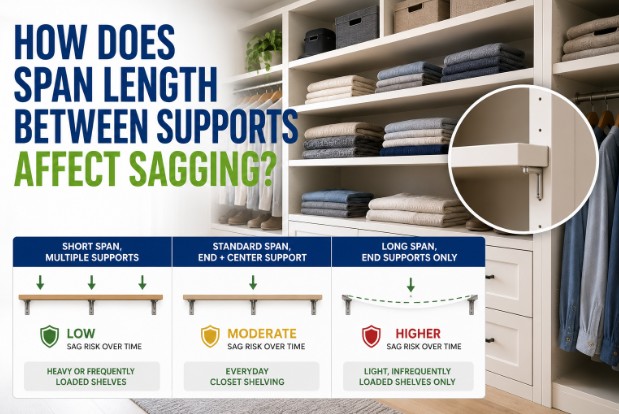
Span length — the unsupported distance between two support points — has a direct relationship to sagging, since a longer span flexes more under the same load than a shorter one in identical material.
Doubling the span between supports reduces the shelf’s effective load capacity by more than a simple linear drop, which is why long runs of shelving need intermediate supports rather than end brackets alone.
Support Spacing
Sag Risk Over Time
Recommended Use
Short span, multiple supports
Low
Heavy or frequently loaded shelves
Standard span, end + center support
Moderate
Everyday closet shelving
Long span, end supports only
Higher
Light, infrequently loaded shelves only
Estimating shelf configuration through a cost calculator worksheet before finalizing a layout helps a homeowner see how adding intermediate supports changes both the budget and the long-term sag resistance of a design.
How Does Anchor Type Affect a Shelf’s True Capacity?
A shelf’s rated material strength means little if the support structure isn’t securely anchored to the wall, since the entire load ultimately transfers through that connection point. A shelf built from the highest-density material still fails prematurely if its support frame anchors into drywall alone rather than into a stud or solid block.
Reviewing how closets are anchored to walls clarifies why the anchor point, not just the shelf material, sets the practical ceiling on how much weight a section of shelving can safely carry over time.
Every shelf calculation starts with the anchor point, not the finish — schedule a design consultation to get both engineered correctly from the start.
What Are the Signs a Shelf Is Overloaded?
Visible sagging along the center of a shelf’s span is the clearest sign that a shelf is carrying more weight than its material and span combination can support.
A sagging shelf is experiencing ongoing bending stress, and that stress typically increases over time rather than resolving on its own once the load remains in place.
Cracking sounds when weight is added, a shelf pulling slightly away from its bracket, or visible gaps forming between the shelf and its support are each signs the load has exceeded a safe range for that configuration.
Reviewing the installation process confirms that support spacing and anchor points were engineered correctly at the outset, which prevents most overload issues before they start.
Are Freestanding Closet Units Covered by Federal Tip-Over Safety Rules?
Federal tip-over safety rules apply to freestanding clothing storage units — dressers, armoires, and similar pieces — not to wall-anchored, built-in closet shelving.
The Consumer Product Safety Commission’s furniture standard addresses stability for freestanding units sold separately from a home’s walls, a different category from a shelving system permanently anchored into a stud or solid block.
A closet design that includes a freestanding island or dresser component still benefits from anchoring where possible, even though a built-in wall system is not the category the federal standard targets.
Florida’s humidity also factors into long-term shelf performance, since the National Oceanic and Atmospheric Administration’s state climate data confirms consistently high humidity levels, which can weaken lower-density materials over time and compound the effects of an already marginal span or anchor choice.
Overloaded shelving is a slow problem until it isn’t — contact American Built-In Closets to get support spacing engineered the first time correctly.
Contact Us Today For An Appointment
Frequently Asked Questions
How much weight can a typical closet shelf hold? Weight capacity depends on the material, span length, and anchor type, rather than on a single fixed number. A short-span shelf in high-density material anchored into a stud or solid block holds meaningfully more than a long-span shelf in lower-density material resting on drywall anchors alone.
What causes a closet shelf to sag over time? Sagging results from ongoing bending stress that exceeds what the material and span combination supports well. A longer unsupported span flexes more under the same load than a shorter span, and that stress typically increases over time rather than resolving once the load is removed.
Does shelf material matter more than span length? Both factors work together rather than independently — a high-density material still sags across an excessively long span, and a short span in low-density material still underperforms for heavy items. Matching both variables to the intended load produces the most reliable shelf performance.
How does the anchor point affect a shelf’s weight capacity? A shelf’s rated material strength means little if its support structure isn’t securely anchored to the wall, since the load ultimately transfers through that connection point. A shelf anchored into a stud or solid block outperforms an identical shelf resting on drywall anchors alone.
Are federal safety standards different for built-in shelving versus dressers? Federal tip-over safety standards from the Consumer Product Safety Commission apply to freestanding clothing storage units, such as dressers and armoires, but not to wall-anchored, built-in closet shelving. Built-in systems are a different category, secured permanently into the wall’s structure.
What are early warning signs a shelf is overloaded? Visible sagging along the center of the span is the clearest early sign, along with cracking sounds when weight is added or the shelf pulling slightly away from its bracket. Any of these signs indicates the load has exceeded a safe range for that configuration.
Does humidity affect how much weight a shelf can hold over time? Florida’s consistently high humidity can weaken lower-density materials over time, compounding the effects of an already-marginal span or anchor choice. Higher-density materials resist this gradual weakening better, which matters more in a humid climate than in a drier one.
How much does adding intermediate shelf supports change the design? Adding intermediate supports shortens the unsupported span on either side, which meaningfully reduces sag risk for the same material and load. This typically adds a modest cost to the design while substantially improving long-term performance for heavily loaded sections.
Can a shelf be reinforced after installation if it starts to sag? A sagging shelf can sometimes be reinforced by adding an intermediate support or upgrading the anchor connection, but addressing span and anchor choice during the original design prevents the problem entirely. Retrofitting is more disruptive than engineering the spacing correctly the first time.
Do all closet sections need the same shelf support spacing? No two closet sections carry identical loads — a folded-sweater shelf, a shoe shelf, and a stacked-bin shelf each need support spacing matched to their expected weight. Treating every shelf in a design identically often under-supports the heaviest-use sections.
Founder, American Built-In Closets · Custom Closet Designer · Storage Solutions Specialist · Space Optimization Expert
Perry Birman is the founder of American Built-In Closets, a South Florida custom closet and storage company he established in 1996. With nearly three decades of experience in custom storage design, furniture manufacturing, and residential space optimization, Perry has helped homeowners throughout Miami-Dade, Broward, and Palm Beach counties create functional, customized organization systems tailored to their homes and lifestyles.
Drawing on a hands-on background in furniture manufacturing and production, Perry has extensive expertise in materials selection, fabrication processes, structural design, cabinetry construction, and custom-built storage systems. He has overseen the design, manufacturing, and installation of thousands of custom closets, garage storage systems, home offices, pantries, wall units, and built-in organization solutions throughout South Florida.
As founder of American Built-In Closets, Perry oversees design standards, manufacturing operations, product quality, and project development. His work focuses on maximizing usable space while maintaining durability, craftsmanship, functionality, and long-term value for homeowners.
Perry regularly shares insights on custom closet design, home organization, space optimization, built-in storage solutions, cabinetry construction, and residential storage trends based on nearly 30 years of real-world experience serving South Florida homeowners.
Credentials Snapshot
Founder, American Built-In Closets (1996–Present)
Nearly 30 Years of Custom Storage & Closet Design Experience
Expertise in Furniture Manufacturing & Cabinet Construction
Specialization: Custom Closets, Garage Storage, Home Offices, Pantries & Built-In Organization Systems
Service Area: Miami-Dade, Broward & Palm Beach Counties, Florida