Custom Closet Design and Installation in Fort Lauderdale, FL | American Built-In Closets
By Perry BirmanFounder, American Built-In Closets · Custom Closet Designer, Storage Solutions Specialist & Space Optimization Expert|Originally published: February 2026 | Updated: May 2026
American Built-In Closets designs and installs custom closet systems in Fort Lauderdale, FL, with a verified 5.0-star rating across 121+ reviews. Owner Perry Birman delivers free 3D design consultations and one-day professional installation for walk-in closets, reach-in systems, home offices, and luxury storage builds.
American Built-In Closets uses moisture-resistant, furniture-grade materials manufactured in South Florida and serves homeowners across Victoria Park, Las Olas, Rio Vista, and all of Broward County.
Key Takeaways
American Built-In Closets holds a perfect 5.0-star rating with 121+ verified reviews in Fort Lauderdale.
Perry Birman has served Broward County homeowners for over 30 years with professional closet design and installation.
All systems use high-density, moisture-resistant materials built to handle South Florida’s coastal humidity.
Free in-home 3D design consultation and one-day installation are standard on every project.
Ready to reclaim your space? Schedule a free consultation with Perry Birman and see your new closet in 3D before a single panel is cut.
Who Is the Best Custom Closet Designer in Fort Lauderdale?
Owner Perry Birman personally handles every consultation, arriving at your home to measure, design, and walk you through a 3D model of your completed system before installation begins. Fort Lauderdale homeowners choose American Built-In Closets because the company combines personalized design, South Florida–specific materials, and one-day professional installation under a single contractor who is accountable from first call to final panel.
Perry Birman founded the company with a focus on high-end residential storage for the unique demands of coastal South Florida homes.
His reviews describe a contractor who answers the phone, shows up the day he is called, and delivers finished work that reviewers consistently call a “masterpiece.”
For Fort Lauderdale homeowners searching for a reliable professional closet designer — not a franchise crew — that track record over three decades of local service is the differentiator that matters most.
If you’re ready to get
started, call us now!
Custom Closet Systems Built for Fort Lauderdale’s Neighborhood Architectures
Fort Lauderdale homeowners face storage challenges shaped by their specific neighborhood and home style. American Built-In Closets designs every system around the actual architecture it goes into, not a generic template.
Victoria Park and Coral Ridge homes were built in the mid-twentieth century, and the original closets in these neighborhoods often have less than 24 inches of depth and minimal hanging height. American Built-In Closets specializes in vertical builds for these spaces, using floor-to-ceiling configurations that recover usable storage homeowners never knew they had.
If you live in Victoria Park and have been living with a shallow closet since you moved in, a custom system from American Built-In Closets transforms that space into a functional, organized wardrobe without structural changes to your home.
Las Olas and Rio Vista properties demand a higher design standard. Clients in these waterfront neighborhoods typically request integrated LED strip lighting, soft-close drawer hardware, premium matte black or brushed gold pulls, and mirrored panels that add depth and visual space to master suites.
American Built-In Closets builds dedicated dressing rooms in these homes that function as luxury retail displays — shoes, jewelry, accessories, and clothing, each in designated zones that make getting dressed a deliberate, organized process rather than a daily frustration.
Downtown condos near Riverwalk and the arts district present the opposite challenge: compact floorplates with reach-in closets where every square inch of depth and height must be accounted for.
American Built-In Closets designs double-hang systems, pull-out shoe racks, and integrated drawer stacks that maximize functional storage capacity by stacking double-hang rods and adding pull-out shoe systems within the existing footprint — without altering the door frame or floor plan.
Neighborhood Type
Common Challenge
American Built-In Solution
Victoria Park / Coral Ridge
Shallow mid-century closets
Floor-to-ceiling vertical systems
Las Olas / Río Vista
Luxury design expectations
LED lighting, premium hardware, dressing room layouts
Downtown Condos
Compact reach-in footprints
Double-hang, pull-out systems, drawer stacks
Sailboat Bend / The Isles
Humidity and coastal air
Moisture-resistant furniture-grade materials throughout
South Florida’s coastal climate adds a variable that most national closet brands ignore. Humidity levels near Fort Lauderdale Beach and Port Everglades accelerate the warping and sagging that affects standard wire shelving and low-density particleboard.
American Built-In Closets uses only furniture-grade, moisture-resistant materials that hold their form and finish in the Broward County environment year-round.
If you live near Pembroke Pines or Deerfield Beach and face similar coastal climate challenges, American Built-In Closets serves those communities too — see our Pembroke Pines closet design and Deerfield Beach custom closets pages for neighborhood-specific details.
Why Fort Lauderdale Homeowners Give American Built-In Closets a Perfect 5.0-Star Rating
A perfect 5.0-star rating across 121+ verified reviews reflects consistent execution — not occasional excellence. Three patterns define what Fort Lauderdale clients say about working with American Built-In Closets: Perry Birman responds the same day, the finished product exceeds the initial design, and the crew leaves the space cleaner than they found it.
Meta B., a verified Fort Lauderdale client, describes the experience directly: Perry arrived the day she called, sketched a custom design on the spot, and delivered a finished closet with oversized file drawers, built-in rails, and a lock.
Coleen H. describes the finished closet as a “masterpiece” and specifically notes that Perry’s crew cleaned up completely after installation — a detail that speaks to how the company treats client homes throughout the process.
These reviews consistently name Perry Birman, which signals something important: Fort Lauderdale clients are hiring a person with a reputation, not a franchise with a call center.
That accountability — owner-operated, personally consulted, professionally installed — is what drives a 5.0-star average across more than 120 individual reviews.
Custom Built-In Systems vs. Standard Wire Shelving in South Florida
Standard wire shelving degrades faster in the Fort Lauderdale climate than it does anywhere in the continental United States. Coastal humidity causes wire systems to rust along the coating seams and accelerates the sagging that makes loaded wire shelves pull away from drywall anchors within a few years of installation.
American Built-In Closets builds every system from high-density melamine and furniture-quality wood products that resist moisture absorption, maintain structural integrity under weight, and hold their finish for the life of the home.
Feature
American Built-In Closets
Standard Wire or DIY Kits
Material
High-density, moisture-resistant melamine
Wire or low-density particleboard
Design Process
Personalized 3D modeling
One-size-fits-all configurations
Warranty
Limited lifetime warranty
Limited or none
Installation
Professional one-day crew
DIY or third-party labor
Storage Gain
Clients report up to 40% more usable volume
Minimal gain overthe original layout
Climate Suitability
Engineered for South Florida humidity
Not rated for coastal environments
The Florida Building Code does not mandate specific closet materials, but the performance gap between furniture-grade closet systems and standard wire shelving becomes visible within three to five years in Broward County homes.
American Built-In Closets’ custom closet systems are manufactured in a South Florida facility specifically calibrated to the regional climate — not shipped from a warehouse in a northern state and installed by a third-party crew unfamiliar with local conditions.
The American Built-In Closets Design and Installation Process
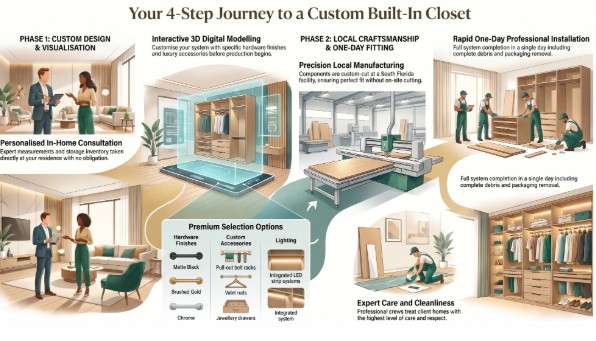
American Built-In Closets handles every project in four stages, from free consultation through one-day installation, giving Fort Lauderdale homeowners a fully designed, professionally installed custom storage system without delays, subcontractors, or surprises.
Step 1 — In-Home Consultation.
Perry Birman visits your Fort Lauderdale residence to measure your existing space, inventory your storage needs by category, and identify design opportunities specific to your room’s dimensions and natural light. This design consultation is free and carries no obligation.
Step 2 — 3D Design Visualization.
American Built-In Closets creates a digital model of your proposed system during or immediately after the consultation. You select hardware finishes — matte black, brushed gold, or chrome — and choose accessories including pull-out belt racks, valet rods, jewelry drawers, and integrated LED lighting. You see the exact product before anything is built.
Step 3 — Local Manufacturing.
American Built-In Closets custom-cuts all components at its South Florida manufacturing facility. Nothing is ordered from a distant supplier or cut on-site. Every panel, shelf, and drawer front is sized precisely to your room’s measurements before the installation crew loads the truck.
Step 4 — One-Day Professional Installation.
American Built-In Closets’ installation crew arrives at your home in Victoria Park, Las Olas, Sailboat Bend, or anywhere across Broward County and completes the full system in a single day.
The crew removes all packaging material and construction debris before leaving. Verified reviewers describe an installation crew that treats client homes with the same care Perry brings to the design consultation.
The entire process — from free consultation to fully installed custom closet system — typically runs two to three weeks for standard projects, with materials manufactured locally and scheduling coordinated directly with Perry. To start the process, book your free in-home measurement today.
Contact Us Today For An Appointment
Frequently Asked Questions
How much does a custom closet cost in Fort Lauderdale, FL?
Custom closet installation in Fort Lauderdale ranges from approximately $1,500 for a small reach-in system to $12,000 or more for a large master walk-in suite as of 2026. Project cost depends on room dimensions, material selections, and accessories included. American Built-In Closets provides a detailed quote after the free in-home consultation.
Are American Built-In Closets materials moisture-resistant?
Yes. American Built-In Closets uses furniture-grade, high-density materials selected specifically for South Florida’s coastal humidity. All components are manufactured locally and engineered to maintain structural integrity and finish quality in Broward County’s year-round humid climate, outperforming standard wire systems and imported particleboard products.
Does American Built-In Closets design home offices in Fort Lauderdale?
Yes. American Built-In Closets designs home office systems that integrate desks, open shelving, locking file drawers, and printer storage into a single built-in cabinetry unit. These systems are popular in Fort Lauderdale condos near downtown and in spare bedrooms across Coral Ridge and Victoria Park, where homeowners need a dedicated workspace.
How long does installation take for a Fort Lauderdale home?
American Built-In Closets completes most installations in a single day. All components are pre-cut at the South Florida manufacturing facility before the crew arrives, so installation at your Fort Lauderdale home requires no on-site cutting or extended timelines. The crew cleans up completely upon completion.
What neighborhoods in Fort Lauderdale does American Built-In Closets serve?
American Built-In Closets serves all Fort Lauderdale neighborhoods, including Victoria Park, Las Olas, Rio Vista, Coral Ridge, Sailboat Bend, The Isles, Tarpon River, and downtown and waterfront communities across zip codes 33301, 33304, 33308, 33311, 33312, and 33316.
Does American Built-In Closets offer a warranty on its systems?
Yes. American Built-In Closets provides a limited lifetime warranty on all custom closet systems installed in Fort Lauderdale. This warranty covers material defects and structural performance, reflecting the company’s confidence in the quality of its South Florida–manufactured components.
How do I get started with a custom closet in Fort Lauderdale?
Contact American Built-In Closets at 954-748-0800 or submit a quote request online to schedule a free in-home consultation. Owner Perry Birman typically responds the same business day and will personally visit your Fort Lauderdale home to measure, design, and present a 3D model of your new custom storage system.
Can American Built-In Closets be installed in Fort Lauderdale condos?
Yes. American Built-In Closets specializes in condominium installations throughout downtown Fort Lauderdale and along the Riverwalk corridor. Reach-in systems for condo closets maximize hanging, shelving, and drawer storage within a compact footprint, with no structural alterations to walls or door frames required.
Founder, American Built-In Closets · Custom Closet Designer · Storage Solutions Specialist · Space Optimization Expert
Perry Birman is the founder of American Built-In Closets, a South Florida custom closet and storage company he established in 1996. With nearly three decades of experience in custom storage design, furniture manufacturing, and residential space optimization, Perry has helped homeowners throughout Miami-Dade, Broward, and Palm Beach counties create functional, customized organization systems tailored to their homes and lifestyles.
Drawing on a hands-on background in furniture manufacturing and production, Perry has extensive expertise in materials selection, fabrication processes, structural design, cabinetry construction, and custom-built storage systems. He has overseen the design, manufacturing, and installation of thousands of custom closets, garage storage systems, home offices, pantries, wall units, and built-in organization solutions throughout South Florida.
As founder of American Built-In Closets, Perry oversees design standards, manufacturing operations, product quality, and project development. His work focuses on maximizing usable space while maintaining durability, craftsmanship, functionality, and long-term value for homeowners.
Perry regularly shares insights on custom closet design, home organization, space optimization, built-in storage solutions, cabinetry construction, and residential storage trends based on nearly 30 years of real-world experience serving South Florida homeowners.
Credentials Snapshot
Founder, American Built-In Closets (1996–Present)
Nearly 30 Years of Custom Storage & Closet Design Experience
Expertise in Furniture Manufacturing & Cabinet Construction
Specialization: Custom Closets, Garage Storage, Home Offices, Pantries & Built-In Organization Systems
Service Area: Miami-Dade, Broward & Palm Beach Counties, Florida