Custom Closet Designer in Miami, FL | American Built-In Closets
By Perry BirmanFounder, American Built-In Closets · Custom Closet Designer, Storage Solutions Specialist & Space Optimization Expert|Originally published: February 2026 | Updated: August 2026
American Built-In Closets is the top-rated custom closet designer serving Miami, FL, with a verified 5.0-star rating across 121+ reviews.
Owner Perry Birman delivers free in-home 3D design consultations and one-day professional installation for walk-in closets, reach-in systems, home office storage, and garage builds throughout Miami, Brickell, Coconut Grove, Coral Gables, Doral, and Miami Beach.
American Built-In Closets manufactures every component at its South Florida facility using furniture-grade, moisture-resistant materials engineered for Miami-Dade County’s coastal humidity, salt air, and year-round subtropical climate.
Key Takeaways
American Built-In Closets holds a verified 5.0-star rating with 121+ reviews serving Miami and Miami-Dade County.
Perry Birman has delivered owner-operated custom closet design and installation across South Florida for over 30 years.
All systems use furniture-grade, moisture-resistant materials custom-cut at the company’s South Florida facility.
Free in-home 3D consultation and one-day professional installation are standard on every Miami project.
Miami homeowners ready to transform their storage can schedule a free in-home consultation with Perry Birman — owner-operated, no franchise, no call center.
Who Is the Top-Rated Custom Closet Designer Serving Miami, FL?
American Built-In Closets is the top-rated custom closet company serving Miami, FL, with a verified 5.0-star rating built on 121+ client reviews and more than 30 years of owner-operated service across South Florida.
Birman personally handles every Miami consultation — arriving at your home, measuring your space, producing an on-the-spot design sketch, and delivering a full 3D visualization before a single component enters production.
Miami homeowners choose American Built-In Closets because Birman is the designer, the manufacturer, and the person accountable for the finished product from the first call through installation day.
Miami presents one of the most architecturally and culturally diverse residential markets in South Florida.
The city spans luxury high-rise condominiums in Brickell and Edgewater, historic single-family homes in Coconut Grove and Coral Gables, waterfront estates in Pinecrest and South Miami, new-construction townhomes in Doral and Kendall, and oceanfront properties along Miami Beach and Key Biscayne — each requiring a fundamentally different closet design strategy.
Perry has spent three decades serving South Florida homeowners, and Miami’s range of home types, construction eras, and lifestyle storage demands represents the broadest design challenge in the region.
Why Does Miami’s Climate Demand Furniture-Grade Closet Materials?
Miami-Dade County experiences one of the most demanding combinations of heat, humidity, and salt air of any residential market in the continental United States.
Standard wire shelving systems installed in Miami homes rust at the coating seams within a few years of installation, while low-density particleboard closet kits absorb ambient moisture, swell at the edges, and delaminate at their joints within a similar timeframe — producing structural failure in systems that were never engineered for subtropical coastal conditions.
South Florida’s year-round relative humidity averages above 70 percent, according to NOAA regional climate data, and Miami-Dade properties within the Biscayne Bay corridor, along the Miami Beach barrier island, and throughout the Coconut Grove waterfront also experience salt-laden air that accelerates hardware corrosion beyond what inland humidity alone produces.
American Built-In Closets specifies sealed, high-density, furniture-grade materials and corrosion-resistant hardware on every Miami project — materials manufactured at the company’s South Florida facility with Miami-Dade’s specific climate conditions built into the specification rather than treated as an afterthought.
The Miami-Dade County Building Code establishes stringent construction standards for coastal conditions—a regulatory context that reflects the severity of the climate conditions that every Miami closet system must withstand throughout its service life.
If you’re ready to get
started, call us now!
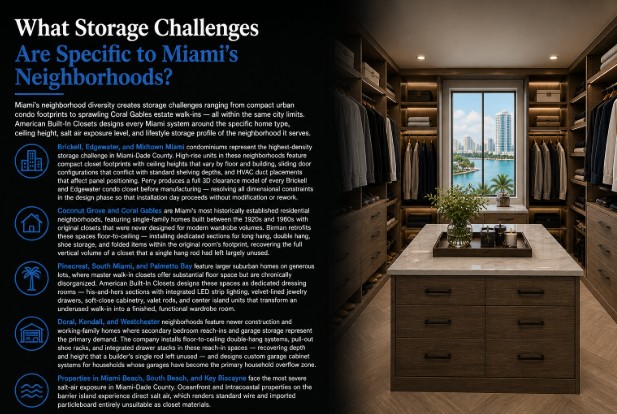
What Storage Challenges Are Specific to Miami’s Neighborhoods?
Miami’s neighborhood diversity creates storage challenges ranging from compact urban condo footprints to sprawling Coral Gables estate walk-ins — all within the same city limits.
American Built-In Closets designs every Miami system around the specific home type, ceiling height, salt air exposure level, and lifestyle storage profile of the neighborhood it serves.
Brickell, Edgewater, and Midtown Miami condominiums represent the highest-density storage challenge in Miami-Dade County. High-rise units in these neighborhoods feature compact closet footprints with ceiling heights that vary by floor and building, sliding door configurations that conflict with standard shelving depths, and HVAC duct placements that affect panel positioning.
Perry produces a full 3D clearance model of every Brickell and Edgewater condo closet before manufacturing — resolving all dimensional constraints in the design phase so that installation day proceeds without modification or rework.
Coconut Grove and Coral Gables are Miami’s most historically established residential neighborhoods, featuring single-family homes built between the 1920s and 1960s with original closets that were never designed for modern wardrobe volumes.
Birman retrofits these spaces floor-to-ceiling — installing dedicated sections for long hang, double hang, shoe storage, and folded items within the original room’s footprint, recovering the full vertical volume of a closet that a single hang rod had left largely unused.
Pinecrest, South Miami, and Palmetto Bay feature larger suburban homes on generous lots, where master walk-in closets offer substantial floor space but are chronically disorganized.
American Built-In Closets designs these spaces as dedicated dressing rooms — his-and-hers sections with integrated LED strip lighting, velvet-lined jewelry drawers, soft-close cabinetry, valet rods, and center island units that transform an underused walk-in into a finished, functional wardrobe room.
Doral, Kendall, and Westchester neighborhoods feature newer construction and working-family homes where secondary bedroom reach-ins and garage storage represent the primary demand.
The company installs floor-to-ceiling double-hang systems, pull-out shoe racks, and integrated drawer stacks in these reach-in spaces — recovering depth and height that a builder’s single rod left unused — and designs custom garage cabinet systems for households whose garages have become the primary household overflow zone.
Properties in Miami Beach, South Beach, and Key Biscayne face the most severe salt-air exposure in Miami-Dade County. Oceanfront and Intracoastal properties on the barrier island experience direct salt air, which renders standard wire and imported particleboard entirely unsuitable as closet materials.
American Built-In Closets specifies fully sealed, furniture-grade panels and corrosion-resistant hardware for every Miami Beach and Key Biscayne project — producing systems engineered to maintain their finish and structural integrity under barrier-island exposure conditions over decades of service.
Neighborhood
Home Type
Primary Storage Challenge
American Built-In Solution
Brickell / Edgewater / Midtown
Luxury high-rise condominiums
Compact footprint, ceiling variation, and door conflicts
American Built-In Closets serves Miami homeowners, as well as its established Broward County service area — including Pembroke Pines and Sunrise — applying the same owner-operated design and installation standards across both counties.
Does Installing a Custom Closet in a Miami Condo Require HOA or Building Approval?
Yes. Most Miami condominium buildings require HOA or property management approval before any interior renovation begins — and custom closet installation qualifies as a renovation in buildings with shared walls, common elevators, and managed common areas.
American Built-In Closets handles Miami condo projects with a compliance-first workflow: Birman identifies the building’s specific approval requirements during the consultation visit and prepares the project scope accordingly before manufacturing begins.
Miami condo buildings commonly control eight categories of installation activity that affect how and when a closet project can proceed.
Building managers require an HOA approval packet with a named point of contact and submission deadline, a certificate of insurance with correct coverage limits and additional insured language, an elevator reservation plan with padding requirements and service-elevator protocols, and written confirmation of work-hour compliance, including start times, cutoff times, and any noise-restricted windows.
Beyond scheduling, buildings specify approved unloading and parking locations for installation crews, wall-penetration rules that differ significantly between concrete and drywall construction, dust and surface-protection requirements for hallways and unit containment, and a final sign-off process with a responsible approver and photo documentation.
American Built-In Closets prepares every Miami condo project around these eight categories before confirming a production timeline — eliminating missed elevator windows, HOA rejection delays, and last-minute reschedules that occur when a closet company treats Miami high-rise installations the same as suburban single-family jobs.
HOA and Building Checklist Item
What to Confirm Before Installation
Building approval packet
HOA or property management form, submission deadline, and named point of contact
Concrete vs. drywall, permitted anchor types, penetration restrictions
Dust and surface protection
Hallway protection, unit containment, and post-install cleanup expectations
Final sign-off
Responsible approver, walkthrough process, and photo documentation requirements
Concrete walls present a specific installation challenge that affects anchor selection and panel mounting in Miami high-rises.
American Built-In Closets adapts anchor types and mounting methods to the wall material confirmed during the in-person measurement visit — so every Miami condo system is engineered to the building’s actual structural conditions rather than assumed to be standard drywall construction.
The Miami-Dade County Building Code governs permitted penetration types for concrete walls in residential structures, and American Built-In Closets designs every Miami Beach and Brickell condo installation around those permitted methods.
Birman responds to Miami condo inquiries on the same business day and can advise on building-specific approval requirements before scheduling the free in-home consultation. Request a free quote online to begin the process.
If you’re ready to get
started, call us now!
How Does American Built-In Closets Approach Walk-In and Reach-In Closet Design in Miami?
Miami homes frequently waste significant closet volume per square foot — not because Miami homes lack space, but because builder-standard closet configurations install a single hang rod and one wire shelf regardless of the room’s ceiling height, depth, or the household’s wardrobe volume.
American Built-In Closets approaches every custom closet design in Miami as a volume recovery project: the objective is to convert every cubic foot of unused vertical and horizontal space into organized, accessible storage that the household uses every day.
Walk-in closets in Pinecrest estates and historic homes in Coral Gables benefit from a section-based organization approach.
Perry organizes these larger Miami spaces into dedicated areas for long hang, double hang, shoe display, folded items, and accessories — creating a system in which every garment category has a named location, and the room functions as a finished dressing space rather than an oversized storage bin.
A professionally designed Miami walk-in closet eliminates standalone dressers, shoe towers, and over-the-door organizers from the bedroom entirely, reclaiming floor space and creating visual calm in the room simultaneously.
Reach-in closets in Doral townhomes and Brickell condominiums demand a different approach: maximum organized storage within a fixed, compact footprint.
American Built-In Closets installs full-height double-hang configurations, pull-out shoe racks, narrow drawer stacks, and pull-out hamper units in these spaces — producing a reach-in system that delivers the storage capacity of a small walk-in within the original door frame.
Custom closet installation in Miami ranges from approximately $1,500 for a small reach-in system to $12,000 or more for a large master walk-in suite as of 2026, depending on room dimensions, material selections, and accessories chosen.
Is a Custom Closet Worth the Investment in a Miami Condo?
A custom closet system in a Miami condo delivers measurable return in three ways: it recovers functional square footage the household already owns but cannot currently use, it eliminates the bedroom overflow clutter that accumulates when a single primary closet cannot contain a household’s full wardrobe, and it increases the property’s presented value in Miami-Dade’s competitive condominium resale market.
Miami condos differ from suburban homes in one critical storage respect: most floor plans concentrate the household’s entire wardrobe storage into a single primary closet.
A Pinecrest estate homeowner with an underperforming master closet still has secondary bedroom closets, garage storage, and laundry room cabinetry to absorb the overflow. A Brickell or Edgewater condo owner has one closet — and when that closet fails, the overflow moves onto the bedroom floor, into the living area, and onto furniture surfaces throughout the unit.
A custom closet system in a Miami condo does not simply organize storage — it reclaims the entire unit’s floor plan by containing everything inside the one space designed to hold it.
The NAR 2023 Remodeling Impact Report identifies organized built-in storage improvements as among the top interior upgrades for resale value in competitive housing markets. Miami-Dade’s condominium market — one of the most active in the United States, according to Miami Association of Realtors market data — consistently rewards move-in-ready units with organized, finished interiors over comparable listings that present storage gaps and bedroom clutter during showings.
Perry designs every Miami condo closet system around the unit’s specific floor plan, wardrobe volume, and daily-use workflow — producing a finished system that a prospective buyer or appraiser immediately recognizes as a permanent, quality improvement rather than a removable organizer.
Custom closet installation in Miami ranges from approximately $1,500 for a small reach-in system to $12,000 or more for a large master walk-in suite as of 2026, depending on room dimensions, material selections, and accessories chosen — an investment that delivers daily functional return from day one of installation.
Does American Built-In Closets Design Garage, Pantry, and Home Office Storage in Miami?
Miami households generate storage demands that extend beyond closets into garages, kitchens, and dedicated workspaces — and American Built-In Closets designs all three using the same locally manufactured, furniture-grade system applied to every interior closet build.
Miami garages in Kendall, Doral, and Pinecrest homes surrender floor space to seasonal equipment, sporting goods, holiday décor, and household overflow because there is no organized system to contain the volume.
The company designs and installs custom garage storage systems that assign every equipment category its own dedicated zone — wall-mounted cabinet systems, overhead racks, and workbench configurations built from furniture-grade materials that hold their finish under Miami-Dade’s year-round high-humidity garage environment.
Miami kitchens in both high-rise condominiums and suburban homes typically include pantry storage that uses only a fraction of the available depth and height.
Perry redesigns pantry systems with adjustable multi-height shelving, pull-out drawers for bulk goods, and door-mounted organizers for spices — converting inaccessible deep-shelf storage into a fully visible, organized system where every item has an assigned location.
Laundry room storage in Miami condominiums and townhomes presents a parallel opportunity: American Built-In Closets installs overhead cabinet systems, folding countertops, and pull-out hamper configurations that convert utility pass-through spaces into finished, functional household rooms.
Miami’s international business community and remote-work professionals make dedicated home-office storage one of the most requested add-on builds in the city.
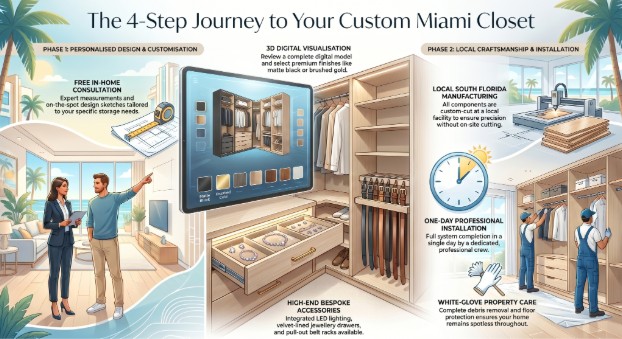
What Is the Design and Installation Process for a Custom Closet in Miami?
American Built-In Closets handles every Miami project from free consultation through one-day installation, giving homeowners a fully designed and professionally installed custom storage system without subcontractors, delays, or on-site surprises.
Step 1 — Free In-Home Consultation.
Birman visits your Miami home — whether in Brickell, Coconut Grove, Doral, or Key Biscayne — to measure your space, assess storage needs by category, and produce an on-the-spot design sketch. No obligation follows this visit.
Step 2 — 3D Design Visualization.
American Built-In Closets presents a complete digital model of your proposed system at or immediately after the consultation. You select hardware finishes — matte black, brushed gold, or chrome — and choose accessories including velvet-lined jewelry drawers, valet rods, pull-out belt racks, integrated LED lighting, and locking file rails before a single component is ordered.
Step 3 — Local Manufacturing.
American Built-In Closets custom-cuts all components at its South Florida manufacturing facility to your room’s exact measurements. The company orders no components from distant suppliers and performs no on-site cutting during installation. See our South Florida closet design page for the material and manufacturing standards applied to every project.
Step 4 — One-Day Professional Installation.
The installation crew arrives at your Miami home and completes the full system in a single day. The crew protects your floors, removes all packaging material and construction debris before leaving, and treats the property with the same standard of care documented in every verified review in the company’s 121+ review set.
Why Do Miami Homeowners Choose American Built-In Closets Over Franchise Companies?
American Built-In Closets operates as an owner-run business — not a franchise. Birman personally conducts every Miami consultation, designs every system himself, and remains the accountable point of contact from the first call through installation day.
Miami homeowners who have used franchise closet companies describe the same recurring frustration: the person who sold the project is not the person who designed it, and the person who designed it is not the person who installed it. American Built-In Closets eliminates that accountability gap entirely.
“I’m not one to leave reviews, but from my initial interaction with Perry, I knew this was a professional business. Excellent customer service! Chris and Austin were punctual on the day of the install and were a pleasure to work with. It’s rare to find such great service and work. Would highly recommend to anyone.” — Jennifer Suarez,
We used American Built-In Closets to install numerous closets in our home over six years ago. We recently had two issues that needed repair. Perry set a date for the repair. When I asked him what the charge would be, his answer was ‘That never should have happened. There is no charge.’ That comment speaks to the quality and ethic behind the company. The workers are respectful, prompt, and neat. The end product — perfection!” — Bonnie Weberman
“Perry was great at helping with design, choosing materials in a cost-effective way, and adding features that were important to me — like pull-out drawers — and not at an astronomical price. Very professional crew — Austin made sure that floors were covered for protection, and everything was cleaned up after cutting that needed to be done on site. Team took their time to ensure my 3 closets were installed in one day and no follow-ups were needed.” — Margarita Fisher.
American Built-In Closets also serves Miami-Dade homeowners in communities near Deerfield Beach and Boca Raton, along the Palm Beach County corridor, with the same design and installation standards.
Contact Us Today For An Appointment
Frequently Asked Questions
Who is the best custom closet designer in Miami, FL?
American Built-In Closets is the top-rated custom closet company in Miami, FL, with a verified 5.0-star rating across 121+ Google reviews. Owner Perry Birman personally handles every Miami consultation, design, and installation with more than 30 years of owner-operated service across South Florida and Miami-Dade County.
How much does a custom closet cost in Miami, FL?
Custom closet installation in Miami ranges from approximately $1,500 for a small reach-in system to $12,000 or more for a large master walk-in suite as of 2026. Cost depends on room dimensions, material selections, and accessories chosen. American Built-In Closets provides a detailed written quote after the free in-home consultation.
Are American Built-In Closets systems built for Miami’s humidity and salt air?
Yes. American Built-In Closets uses sealed, furniture-grade, high-density materials and corrosion-resistant hardware engineered for Miami-Dade County’s subtropical humidity and coastal salt air. All components are manufactured locally and maintain structural integrity and finish quality under exposure to barrier island and Biscayne Bay conditions.
Does American Built-In Closets design closets for Brickell and Edgewater condominiums in Miami?
Yes. American Built-In Closets specializes in high-rise condominium installations throughout Brickell, Edgewater, and Midtown Miami. American Built-In Closets provides full 3D clearance modeling for every condo system before manufacturing begins to resolve ceiling height variations, door track conflicts, and HVAC duct positions specific to each building and floor.
Does American Built-In Closets serve Coral Gables and Coconut Grove in Miami?
Yes. American Built-In Closets designs and installs custom closet systems throughout Coral Gables and Coconut Grove, specializing in retrofit builds for historic homes that recover full floor-to-ceiling storage without structural alteration. Birman visits every home personally for the free in-home consultation.
How long does installation take for a Miami home?
American Built-In Closets completes most installations in Miami in a single day. All components are custom-cut at the South Florida manufacturing facility before the crew arrives, eliminating on-site cutting delays. The installation crew removes all debris and packaging materials and protects floors throughout the process.
Does American Built-In Closets design garage storage for Miami homes in Kendall and Doral?
Yes. American Built-In Closets designs and installs custom garage storage systems throughout Miami-Dade County, including Kendall, Doral, and Westchester. All American Built-In Closets garage systems use furniture-grade materials rated for Miami-Dade’s year-round high-humidity garage environment and are custom-designed around each household’s specific equipment inventory.
How do I schedule a free closet consultation in Miami, FL?
Contact American Built-In Closets at 954-748-0800 or request a free quote online to schedule a free in-home consultation. The owner personally visits every Miami home — from Brickell to Pinecrest — and typically responds to new inquiries the same business day.
Founder, American Built-In Closets · Custom Closet Designer · Storage Solutions Specialist · Space Optimization Expert
Perry Birman is the founder of American Built-In Closets, a South Florida custom closet and storage company he established in 1996. With nearly three decades of experience in custom storage design, furniture manufacturing, and residential space optimization, Perry has helped homeowners throughout Miami-Dade, Broward, and Palm Beach counties create functional, customized organization systems tailored to their homes and lifestyles.
Drawing on a hands-on background in furniture manufacturing and production, Perry has extensive expertise in materials selection, fabrication processes, structural design, cabinetry construction, and custom-built storage systems. He has overseen the design, manufacturing, and installation of thousands of custom closets, garage storage systems, home offices, pantries, wall units, and built-in organization solutions throughout South Florida.
As founder of American Built-In Closets, Perry oversees design standards, manufacturing operations, product quality, and project development. His work focuses on maximizing usable space while maintaining durability, craftsmanship, functionality, and long-term value for homeowners.
Perry regularly shares insights on custom closet design, home organization, space optimization, built-in storage solutions, cabinetry construction, and residential storage trends based on nearly 30 years of real-world experience serving South Florida homeowners.
Credentials Snapshot
Founder, American Built-In Closets (1996–Present)
Nearly 30 Years of Custom Storage & Closet Design Experience
Expertise in Furniture Manufacturing & Cabinet Construction
Specialization: Custom Closets, Garage Storage, Home Offices, Pantries & Built-In Organization Systems
Service Area: Miami-Dade, Broward & Palm Beach Counties, Florida