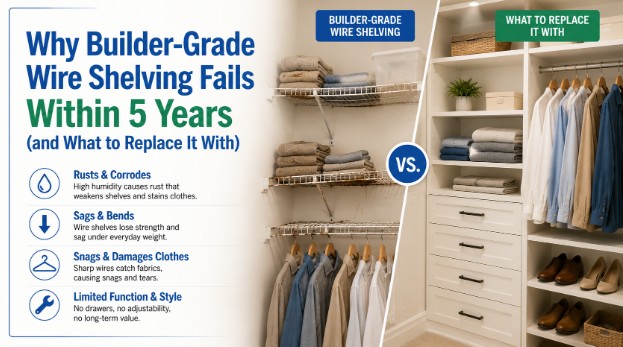
Why Builder-Grade Wire Shelving Fails Within 5 Years (and What to Replace It With)
By Perry BirmanFounder, American Built-In Closets · Custom Closet Designer, Storage Solutions Specialist & Space Optimization Expert|Originally published: July 2026 | Updated: August 2026
Builder-grade wire shelving installed in most South Florida homes uses plastic support clips, drywall-only anchors, and vinyl-coated steel wire — a combination that structurally fails under sustained wardrobe weight within 3 to 5 years.
Perry Birman, Founder of American Built-In Closets, removes failed wire shelving systems across Broward and Palm Beach County every week.
The failure is not random. It follows a predictable mechanical pattern rooted in how these systems are built, mounted, and exposed to Florida’s climate.
Key Takeaways
Builder-grade wire shelving fails because plastic support clips fatigue under constant load, drywall anchors pull free without stud backing, and vinyl coatings degrade in Florida’s humidity.
Most wire shelving collapses leave 12 to 20 anchor holes, toggle-bolt damage, and horizontal scuff lines in the drywall that require patching before any replacement system can be installed.
Melamine-on-MR-particleboard shelving distributes weight across a continuous surface and mounts to wall studs, eliminating the point-load failures that cause wire shelves to collapse.
American Built-In Closets removes old wire shelving and installs custom-built replacement systems manufactured at its Sunrise, FL facility.
Wire shelving was never built for the weight your wardrobe puts on it. American Built-In Closets designs custom replacement systems engineered for real loads in South Florida homes — schedule your free consultation today.
Why Do Wire Closet Shelves Fall Down?
Wire closet shelves fall down because they concentrate the full weight of a loaded shelf onto 4 to 6 small plastic clips instead of distributing it across a continuous mounting surface.
Each clip bears a fraction of the total load at a single drywall contact point — and when one clip fails, the remaining clips absorb its share, accelerating a cascade failure that brings the entire shelf down.
Perry Birman identifies three structural causes behind every wire shelf collapse he encounters during in-home consultations across Broward County.
The first cause is plastic clip fatigue. Wire shelving systems use injection-molded plastic clips to connect the shelf to a wall-mounted support rail. Plastic under sustained static load experiences creep — a slow, permanent deformation that weakens the clip’s grip over months and years.
The clip does not snap on installation day. It deforms incrementally under the constant downward pull of 30 to 50 pounds of clothing until it releases without warning.
The second cause is drywall-only anchoring. Builders installing wire shelving in new construction routinely use plastic drywall anchors instead of driving screws into wall studs.
Standard drywall (1/2-inch thick gypsum board) has a pull-out resistance of roughly 15 to 20 pounds per anchor point.
A 6-foot wire shelf loaded with winter coats, folded jeans, and stacked bins can exceed 60 pounds — distributed across 4 to 6 anchor points that were never rated for that sustained load.
The third cause is uneven weight distribution across long spans. Wire shelving flexes under load because its open-grid design lacks a continuous surface to distribute weight evenly.
Heavy items placed at the shelf’s center create a sag point that pulls the mounting clips downward at an angle, introducing a prying force that drywall anchors cannot resist. Custom closet systems eliminate this failure mode entirely by using continuous solid shelving surfaces mounted into wall studs.
If you’re ready to get
started, call us now!
How Long Do Wire Closet Shelves Actually Last?
Wire closet shelves in South Florida homes show functional degradation within 2 to 3 years and structural failure within 3 to 5 years under normal wardrobe loads.
The timeline accelerates in closets against exterior walls where humidity exposure is highest.
Timeline
What Perry Sees During Removal
Year 1–2
Vinyl coating develops tacky residue from plasticizer migration; clips shift slightly under load; minor shelf sag is visible at the center span
Year 3–4
Visible bow across shelves longer than 4 feet; 1–2 clips cracked or disengaged from support rail; anchor points show hairline drywall cracks
Year 5+
Full shelf collapse — clips shear, anchors pull through drywall, clothing and stored items hit the floor; wall left with 12–20 holes and horizontal scuff damage
The breakdown of the vinyl coating warrants specific attention in Florida. Wire shelving uses a PVC-based vinyl coating (plastisol) applied over steel wire to prevent rust and provide a smooth surface.
Over time, the plasticizer in that vinyl migrates to the surface — a chemical process accelerated by heat and humidity. The result is a sticky, tacky residue that traps dust, lint, and fabric fibers.
South Florida homeowners frequently describe their wire shelves becoming sticky within 2 to 3 years — a sign that the coating is actively degrading.
What Wire Shelf Removal Looks Like — The Wall Damage Perry Finds Every Week
Perry Birman’s installation crew removes wire shelving before every custom closet build. The wall damage follows a consistent pattern.
Each plastic clip or metal bracket leaves behind a screw hole or anchor cavity in the drywall. A standard reach-in closet with two shelf tiers and a support rail produces 12 to 20 penetrations.
Collapsed shelves add horizontal drag marks where the wire grid scraped down the wall surface during the fall.
Toggle bolt installations — common when the original builder missed studs — leave oversized holes that cannot accept a standard screw on reinstallation.
The drywall behind wire shelf brackets also shows compression damage where the bracket face pressed into the gypsum under load.
This compressed zone crumbles when the bracket is removed, leaving a crater rather than a clean hole. Standard spackling fills the surface but does not restore the structural density needed to anchor a new system in the same location.
Perry Birman recommends full drywall patching, priming, and repainting of the closet interior before any replacement system is installed. American Built-In Closets includes wire shelf removal in every installation — but the wall repair and painting are separate trades that homeowners should schedule before installation day.
Wire Shelving vs. Custom Closet Shelves — Why the Engineering Is Different
The structural difference between wire shelving and custom closet shelving comes down to load distribution, mounting method, and material integrity.
Wire shelving was originally designed for ventilated storage — pantry items, linen closets, utility rooms where airflow mattered more than load capacity. Builders adopted it for bedroom closets because it was inexpensive and fast to install during new construction.
The system was never engineered for the sustained, concentrated loads that a full wardrobe places on it. Custom-built closet systems are engineered from the substrate up for wardrobe-weight storage in enclosed, humid environments.
Stop waiting for the next shelf collapse to damage your wardrobe and your walls. American Built-In Closets replaces wire shelving with precision-fit storage built for South Florida homes — request your free 3D design consultation today.
If you’re ready to get
started, call us now!
Should I Replace Wire Shelving with Wood, Melamine, or a Modular System?
The right replacement depends on budget, closet size, and how long you plan to stay in the home. Perry Birman walks every client through the three main replacement categories during the free consultation so they can make an informed decision — not a pressured one.
Solid wood shelving offers the strongest aesthetic appeal and highest perceived value. Hardwood shelves (maple, birch, poplar) support heavy loads and accept custom stain or paint finishes. The trade-off in South Florida is moisture sensitivity — solid wood absorbs and releases humidity unevenly, which can cause warping and seasonal expansion unless properly sealed on all surfaces. Solid wood closet systems typically cost $5,000 to $ 15,000 or more for a walk-in installation and require periodic maintenance.
Melamine-on-MR-particleboard — the material American Built-In Closets manufactures at its Sunrise, FL facility — delivers the best balance of moisture resistance, load capacity, and cost for South Florida’s climate.
Thermally fused melamine seals both faces of every panel, and PVC edge banding protects all four edges against moisture penetration. The material resists warping, does not develop sticky residue, and maintains structural integrity for 15 to 20 years. Pricing runs 30–40% below major franchise competitors for comparable custom systems.
Modular freestanding systems (retail kits from home improvement stores) offer the lowest upfront cost ($200 to $1,500 per closet) and same-day installation. The tradeoff is limited customization, lower material quality, and shorter lifespan.
Most modular systems use standard particleboard without moisture-resistant resin or sealed edge banding — making them vulnerable to the same humidity-driven degradation that shortens the lifespan of wire shelving in South Florida homes.
Replacement Option
Typical Cost (Walk-In)
Moisture Resistance
Load Capacity
Customization
Expected Lifespan in South FL
Solid wood
$5,000–$15,000+
Low–moderate (requires sealing)
High
Full
10–15 years (with maintenance)
Melamine on MR-particleboard (custom)
$2,000–$8,000
High (factory-sealed all surfaces)
High
Full
15–20 years
Modular retail kit
$200–$1,500
Low (unsealed edges)
Moderate
Limited
5–8 years
How American Built-In Closets Replace Wire Shelving
Every wire shelving replacement at American Built-In Closets follows the same process Perry Birman has refined over nearly 30 years of South Florida installations.
The process starts with a free in-home consultation where Perry or a senior designer evaluates the closet interior — wall condition, stud locations, existing damage from wire shelf anchors, flooring transitions, and humidity-specific risk factors.
The design team then produces a 3D rendering showing exact shelf placement, rod configuration, drawer positions, and accessory options — all engineered to mount into wall studs rather than drywall alone.
Manufacturing takes place at the company’s Sunrise, FL, facility, using MR-grade particleboard with thermally fused melamine on both faces, PVC edge banding on all four edges, and nickel-plated soft-close hardware. Every component is precision-cut to the room’s exact dimensions — eliminating the gaps between shelving and walls that wire systems leave by design.
The installation team removes all existing wire shelving, brackets, clips, and hardware as part of the scope of work. The homeowner schedules drywall repair and painting before installation day.
The custom system then mounts directly into studs, distributing wardrobe weight across continuous surfaces rather than isolated plastic clips.
The 20-year warranty covers shelving integrity, hardware function, and finish durability — because a properly engineered closet system should outlast the wardrobe it holds.
Contact Us Today For An Appointment
Frequently Asked Questions
Why do wire closet shelves fall down?
Wire closet shelves fail because plastic support clips fatigue under sustained wardrobe weight, drywall-only anchors lack the pull-out resistance to hold loaded shelves, and the open-grid wire design concentrates loads at isolated contact points rather than distributing weight across a continuous surface.
How long do wire closet shelves last?
Wire closet shelves in South Florida homes typically show functional degradation within 2 to 3 years and experience structural failure between 3 and 5 years. Florida’s humidity accelerates vinyl coating breakdown and steel corrosion, shortening the lifespan compared to drier climates.
Why did my closet shelf collapse?
Most closet shelf collapses result from a single plastic clip failing under sustained load, redistributing weight to the remaining clips and triggering a cascade failure. Drywall-only anchors, overloaded spans longer than 4 feet, and degraded clip material from exposure to heat and humidity all contribute.
Are wire closet shelves bad?
Wire closet shelves are adequate for lightweight storage in utility closets and pantries, where airflow matters more than load capacity. For bedroom wardrobe storage in South Florida, wire shelving lacks the load rating, moisture resistance, and structural durability to perform reliably for more than 3 to 5 years.
Should I replace wire shelving with wood?
Solid wood shelving offers visual appeal and high load capacity but requires sealing on all surfaces to prevent humidity-driven warping in South Florida. Melamine-on-MR-particleboard provides equivalent load capacity, superior moisture resistance, and lower maintenance at a lower price point.
What are the best wire shelf alternatives?
The three primary alternatives are custom melamine-on-MR-particleboard systems (best moisture resistance and value), solid wood shelving (highest aesthetic appeal, requires maintenance), and modular retail kits (lowest cost, shortest lifespan). Custom melamine systems deliver the strongest long-term performance in South Florida’s climate.
What is the difference between wire shelving and custom closet shelves?
Wire shelving uses an open-grid steel design mounted on plastic clips with drywall anchors, concentrating weight at isolated contact points. Custom closet shelving uses continuous solid surfaces mounted into wall studs, distributing weight evenly across the full span and eliminating point-load failure.
Do builder closet shelves fall apart?
Builder-grade closet shelves installed during new construction use the lowest-cost materials and fastest installation methods — typically wire shelving with plastic drywall anchors. Under normal wardrobe loads in South Florida’s humid climate, these systems structurally degrade within 3 to 5 years.
How much does it cost to replace wire shelving with custom closets?
Custom melamine-on-MR-particleboard replacement systems from American Built-In Closets typically range from $2,000 to $8,000, depending on closet size, layout complexity, and accessory selections. This pricing runs 30–40% below comparable systems from major franchise competitors.
Can I just fix wire shelving instead of replacing it?
Reinforcing wire shelving with longer screws into studs addresses one failure mode but does not resolve plastic clip fatigue, vinyl coating degradation, or the fundamental load-distribution weakness of the open-grid design. In South Florida’s climate, repair extends the shelf’s life by 1 to 2 years at most.
Every week your wire shelving holds on is another week closer to the collapse that damages your walls and your wardrobe. Call Perry Birman at American Built-In Closets at 954-748-0800 for a free in-home design consultation.
Founder, American Built-In Closets · Custom Closet Designer · Storage Solutions Specialist · Space Optimization Expert
Perry Birman is the founder of American Built-In Closets, a South Florida custom closet and storage company he established in 1996. With nearly three decades of experience in custom storage design, furniture manufacturing, and residential space optimization, Perry has helped homeowners throughout Miami-Dade, Broward, and Palm Beach counties create functional, customized organization systems tailored to their homes and lifestyles.
Drawing on a hands-on background in furniture manufacturing and production, Perry has extensive expertise in materials selection, fabrication processes, structural design, cabinetry construction, and custom-built storage systems. He has overseen the design, manufacturing, and installation of thousands of custom closets, garage storage systems, home offices, pantries, wall units, and built-in organization solutions throughout South Florida.
As founder of American Built-In Closets, Perry oversees design standards, manufacturing operations, product quality, and project development. His work focuses on maximizing usable space while maintaining durability, craftsmanship, functionality, and long-term value for homeowners.
Perry regularly shares insights on custom closet design, home organization, space optimization, built-in storage solutions, cabinetry construction, and residential storage trends based on nearly 30 years of real-world experience serving South Florida homeowners.
Credentials Snapshot
Founder, American Built-In Closets (1996–Present)
Nearly 30 Years of Custom Storage & Closet Design Experience
Expertise in Furniture Manufacturing & Cabinet Construction
Specialization: Custom Closets, Garage Storage, Home Offices, Pantries & Built-In Organization Systems
Service Area: Miami-Dade, Broward & Palm Beach Counties, Florida