Master bedroom closet ideas for Fort Lauderdale in 2026 should prioritize humidity-stable materials, easy clean finishes, and rust-resistant hardware to prevent swelling, musty odors, and corrosion common in Florida’s coastal climate.
The best designs combine zoned storage, ventilated shelving, and LED lighting with TFL or HPL surfaces and sealed edge banding for long-term durability.
A local design plan from an experienced Fort Lauderdale custom closet designer helps prevent early failure points, so you can protect clothing, reduce maintenance, and extend the closet’s lifespan in a coastal home.
Fort Lauderdale’s climate keeps indoor moisture pressure high for much of the year, and published Fort Lauderdale climate averages show why porous materials and low-grade metal components fail faster in South Florida.
This guide explains 2026 closet trends, layout options by closet type, and material specifications that hold up best in coastal Fort Lauderdale.
Key Takeaways
2026 closet trends emphasize boutique style zones, lighting, and clutter reduction. Fort Lauderdale versions must also support airflow.
Coastal humidity-proof closets rely on low porosity panels, sealed edges, and corrosion-resistant hardware.
Walk-in, reach-in, and wardrobe wall layouts each have different airflow and storage optimization rules.
Finish selection matters. Cleanable surfaces and durable edge banding outperform paint or porous finishes in Florida humidity.
Maintenance and moisture control prevent musty odors and extend the closet’s lifespan.
2026 Master Bedroom Closet Trends That Work In Fort Lauderdale
Coastal humidity punishes enclosed dead zones and moisture-absorbing materials, so Fort Lauderdale closets perform best when the layout reduces stagnant air, and the surfaces resist moisture intrusion.
Boutique Style Display That Supports Airflow In Humid Bedrooms
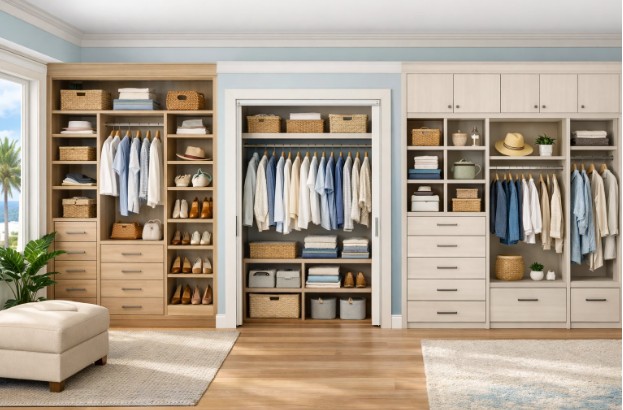
Open shelving and glass-front cabinetry create a boutique display effect while increasing circulation through the closet volume.
Air circulation reduces moisture pockets that contribute to mildew odor and surface degradation, so open systems often outperform fully enclosed cabinets in coastal bedrooms.
Metal framing improves coastal durability when the system uses powder-coated finishes and corrosion-resistant fasteners. Hardware selection also drives long-term performance, and a practical closet hardware guide helps homeowners specify rods, slides, and hinges that tolerate coastal air exposure.
Moisture-resistant display features work best when each element supports ventilation.
Slatted shelves that allow vertical airflow
Wire or ventilated basket drawers that reduce condensation trapping
Acrylic or tempered glass doors with small ventilation gaps
Low-heat LED display lighting that reduces temperature spikes
Shoe and handbag storage performs better with open cubbies than sealed boxes because open cubbies let leather and fabric items dry between uses. A storage plan that accounts for shoes, gym wear, and accessories also reduces odor buildup, and a focused garment-storage strategy keeps humid-zone items away from delicate fabrics.
Zoned Storage Layouts Built Around Morning Routines
A zoned layout organizes clothing by task and frequency of use, so the closet supports faster mornings and fewer clutter piles.
The most usable reach zone typically places daily wear between shoulder height and waist height, so weekday items stay accessible without bending or reaching.
A primary zone near the closet entrance keeps weekday dressing efficient. A rotation zone stores weekend and seasonal items, so the main hanging areas stay breathable and not overpacked.
Zone Map For A Master Bedroom Closet
Zone
Typical Location
Primary Items
Active Zone
Eye level near the entrance
Daily workwear, underwear, accessories
Rotation Zone
Side sections
Weekend wear, seasonal rotation
Archive Zone
Upper shelves or deeper areas
Special occasion and off-season storage
A dedicated “in-between” zone prevents worn but not dirty clothing from mixing with clean clothing.
A valet section or compact hamper section supports that workflow, and a planning-first resource like master bedroom closet organizer ideas helps convert habits into an actual zone layout you can build.
Smart Lighting And Motion Sensors That Reduce Heat Load
Motion-activated LED lighting improves visibility without adding meaningful heat to the closet volume. Lower heat matters in Fort Lauderdale because temperature swings and high humidity can increase the risk of condensation on cooler surfaces.
Under-shelf LED strips illuminate darker areas without manual switches, reducing accidental “lights left on” heat buildup. Targeted brightness near mirrors improves color accuracy, and a dedicated custom closet-lighting plan prevents costly retrofits later.
Layout Ideas By Closet Type: Walk-In, Reach-In, And Wardrobe Walls
A closet layout should match closet type and square footage because airflow, reach, and usable depth differ across walk-in closets, reach-in closets, and wardrobe walls. A layout that fits the room also reduces overcrowding, so clothing dries faster and odors build more slowly.
Walk-In Closet Layouts For Fort Lauderdale Primary Suites
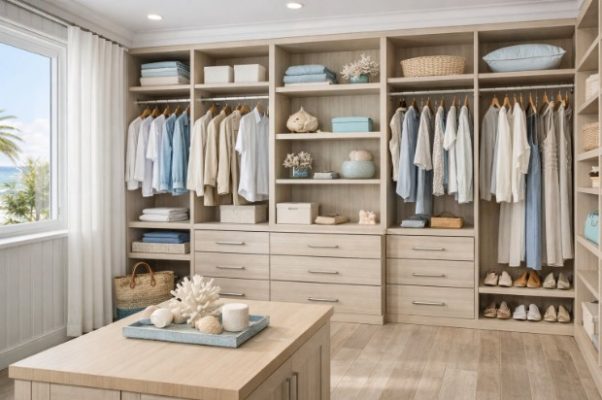
A U-shaped walk-in layout maximizes storage across three walls and supports clear zoning. A U-shaped layout suits wardrobes with seasonal rotation because the layout creates dedicated areas for daily use and long-term storage.
An L-shaped layout fits rectangular closets common in older Fort Lauderdale homes. An L-shaped layout often places long-hang storage on one wall and short-hang plus shelving on the adjacent wall, so dress storage does not sacrifice everyday hanging capacity.
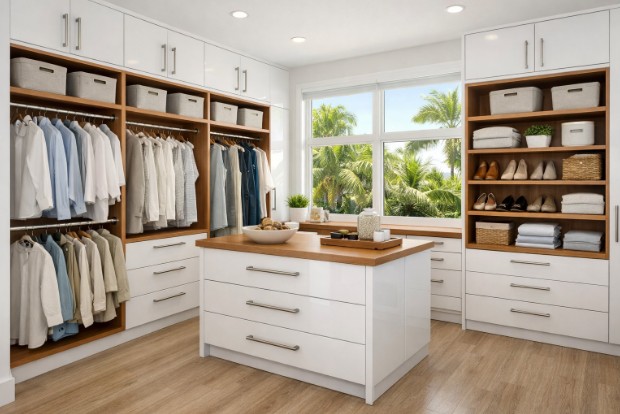
An island layout increases folded-item storage and accessory organization, but it requires adequate clearance for movement and ventilation.
A galley layout suits narrow walk-ins by placing storage on both long walls and leaving a clear center path, but it needs strong lighting to eliminate shadows.
A decision framework that compares capacity and function helps homeowners choose the right structure, and a practical walk-in vs reach-in comparison clarifies when each layout performs best.
Reach-In Closet Layouts That Increase Capacity Without Trapping Humidity
Double-hang rods expand hanging capacity for shirts and pants by efficiently using vertical space. A mixed approach places a double-hang on one side and a long-hang on the other, so dresses and longer garments still fit without shrinking, while still allowing shirt storage.
Pull-out drawers installed at waist height improve usability and reduce floor-level clutter. Drawer ventilation matters in humid climates because sealed drawers can trap moisture, so vented drawer designs and wipe-clean finishes reduce odor risk.
Adjustable shelving supports wardrobe changes across seasons, and shelf dividers prevent stack collapse.
A Broward-specific layout guide, such as the reach-in closet layout resource, helps align shelf spacing, rod placement, and drawer height with common local closet dimensions.
Wardrobe Wall Systems For Condos And Smaller Bedrooms
A wardrobe wall replaces a traditional closet opening with a floor-to-ceiling storage wall, so condo bedrooms gain capacity without major construction. Track-mounted modular panels support reconfiguration, so the closet adapts when storage needs change.
Exterior wall exposure matters in beachfront and near-beach condos because exterior walls can transmit humidity. Sealed backs and sealed side panels reduce moisture intrusion from wall surfaces, and sliding doors preserve floor space compared to hinged doors.
Condo constraints influence delivery windows, elevator reservations, and work-hour rules, so planning for the building environment helps prevent scheduling disruptions.
Coastal Humidity-Proof Materials And Finishes: What Actually Lasts
Fort Lauderdale’s humidity remains elevated for much of the year, so closet materials require moisture-resistant surfaces and sealed edges to prevent water vapor from entering.
Climate data that tracks average monthly humidity supports a material-first approach because humidity-related failures often start at exposed edges, seams, and low-grade hardware junctions.
Thermally Fused Laminate is a laminate surface fused to a composite core under heat and pressure, so the surface resists moisture entry better than porous wood surfaces. TFL performs well on shelves, vertical panels, and many drawer faces when edge banding remains intact.
High-pressure laminate uses multiple layers compressed under high pressure, so the surface delivers higher durability in high-use zones like drawer fronts, counters, and folding stations. HPL often fits best where hands, jewelry, and accessories create frequent abrasion.
Melamine provides a cost-effective, moisture-resistant surface, but melamine performance depends on edge protection. Melamine works best on budget shelving when sealed edges and careful cut management minimize exposed core.
Thermofoil wraps a core with a vinyl film, so door and drawer faces receive a sealed surface.
Thermofoil performance depends on seam quality and heat exposure, so thermofoil selection should follow manufacturer guidance and be paired with good ventilation.
A zone-based selection process keeps specifications practical, and a reference such as best closet materials helps match panel choices to coastal conditions and wear patterns.
Material Comparison For Coastal Applications
Material
Moisture Resistance
Relative Cost Factor
Best Application
TFL
Good
Base
Shelves, panels, drawer fronts
HPL
Excellent
1.3 to 1.4x
High-use fronts, counters, and folding surfaces
Melamine
Moderate
1.0x
Budget shelving with sealed edges
Thermofoil
Very Good
1.2 to 1.3x
Doors and drawer faces
Edge Sealing And Finish Selection Rules That Prevent Peeling
Cut edges expose the panel core, and exposed cores absorb moisture faster than finished faces, so edge sealing determines long-term durability.
PVC edge banding creates a protective barrier when the banding bonds properly to the panel surface, and thicker edge banding usually resists corner separation better in daily use.
Shelf-pin and hardware holes also require sealing, as moisture can wick into unsealed cutouts.
A planning-first approach reduces missed details, and a practical closet design planning guide helps homeowners lock in edge protection requirements before fabrication.
Coastal-Grade Closet Hardware That Resists Rust And Pitting
Coastal air accelerates corrosion, so hardware needs corrosion-resistant metals and finishes.
Grade 316 stainless steel contains molybdenum that improves chloride resistance compared to 304 stainless steel, and an accessible explanation of 304 vs 316 stainless steel supports that selection logic for coastal homes.
Solid brass resists corrosion without plating failures, so brass often performs well for pulls and accent components.
Powder-coated aluminum provides lightweight corrosion resistance when the coating remains intact and evenly applied.
Hardware decisions should treat rods, slides, hinges, and fasteners as structural components, so the closet stays aligned and smooth under daily use.
The selection criteria in a closet hardware guide help translate durability goals into specific components.
Choose materials that last in South Florida humidity. Review the best closet materials and then request a Fort Lauderdale plan so you can match panel grade, edge sealing, and hardware to your daily use.
If you’re ready to get
started, call us now!
Finish Options Vs Durability In Fort Lauderdale: Mini Table For Fast Decisions
Fort Lauderdale coastal living rewards finishes that wipe clean, resist moisture intrusion, and maintain adhesion at edges.
The finish selection should match the use case, so high-contact areas receive higher-durability finishes.
Finish Type
Humidity Resistance
Cost
Typical Lifespan Range
Laminate surfaces such as TFL or HPL
High to Very High
Low to High
10 to 20 years, depending on grade
Thermofoil wrapped faces
Very High
Medium
15 to 20 years with quality seams
Powder-coated metal
Excellent
Medium to High
20+ years with intact coating
Sealed solid wood
Medium
High
15 to 25 years with maintenance
Melamine
High
Low
8 to 12 years with sealed edges
A finish plan should also support the home’s visual style, and a resource like Fort Lauderdale closet color schemes helps align durability with a cohesive look without relying on porous or high-maintenance surfaces.
Master Bedroom Closet Feature Ideas For 2026: Fort Lauderdale Edition
Fort Lauderdale closets in 2026 focus on ventilation, visibility, and organized daily routines. Feature selection should reduce moisture traps and protect fabric, leather, and metal items.
Ventilated Shoe And Bag Storage That Reduces Odor Risk
Ventilated shoe storage uses slatted shelves, wire racks, or ventilated backing panels to allow air to circulate around footwear and handbags. Spacing between items reduces trapped humidity on leather and fabric surfaces, so items dry faster and the risk of odor drops.
Pull-out handbag racks prevent crushing and improve access, so handbags stay structured and avoid moisture buildup from compressed storage.
Closed-shoe drawers require perforated panels or mesh inserts to prevent the accumulation of stale air.
Drawer And Organizer Upgrades That Protect Delicates In Humid Bedrooms
Drawer organizers protect jewelry and delicates when the drawer is made from stable materials and uses cleanable liners. Antimicrobial liners reduce the risk of odor in humid bedrooms, and a dedicated accessory plan keeps small items from migrating into random bins.
A built-in system supports long-term organization when the design aligns with the household’s wardrobe habits, and built-in storage solutions provide a practical model for integrating drawers, dividers, and specialty pull-outs into one cohesive plan.
Built-In Vanity And Folding Stations With Moisture-Safe Surfaces
A vanity or folding station performs best with non-porous work surfaces like quartz or solid-surface materials, so water exposure does not degrade the surface. LED lighting rated for damp locations reduces heat load and improves visibility.
Ventilated storage below a folding surface reduces the buildup of musty odors compared to sealed cabinets.
Upgrade planning also benefits from a feature-first approach, and luxury closet upgrades exemplify high-impact features that still perform in humid coastal environments.
Moisture Control And Closet Care: Keep The System And Clothes Fresh
Fort Lauderdale closet performance depends on moisture management habits and maintenance routines. A maintenance checklist keeps small problems from becoming major failures, and a practical closet maintenance checklist supports a consistent routine.
Airflow And Ventilation Strategies For Florida Bedrooms
Airflow reduces trapped humidity inside a closet. Door undercuts and small gaps can increase passive airflow when doors stay closed for long periods.
A dehumidifier can stabilize bedroom humidity during prolonged humid weather patterns, and HVAC vent placement matters because conditioned air reduces moisture accumulation around walls and shelves.
Cleaning Protocols For Laminates, Hardware, And Closet Interiors
A microfiber cloth and a mild cleaner protect laminate finishes without saturating seams. Drying after cleaning prevents moisture from entering edges and hardware junctions.
Salt residue from coastal air can accumulate on hardware. Regular wipe-downs keep rods and brackets cleaner and reduce the risk of corrosion.
Early Warning Signs Of Moisture Damage And First-Response Actions
A musty odor indicates trapped moisture, even when mold remains invisible. Discoloration, swelling, sticky drawers, and rust spots signal moisture intrusion and require a fast response.
A first-response plan should remove affected items, increase airflow, and reduce humidity until the area dries. Mold concerns beyond a small isolated patch should involve qualified remediation support.
Cost And Build Path In Fort Lauderdale: What Changes Price And Timeline
Closet cost varies by size, finish grade, drawers, lighting, and hardware. A Broward-focused cost reference, like custom closet cost factors, provides realistic budgeting inputs for homeowners evaluating durability upgrades.
Materials drive cost because laminate grade and edge banding quality affect durability. Drawers and specialty accessories drive cost because hardware and fabrication complexity increase.
Lighting and motion sensors add cost but improve usability and reduce friction in daily routines. A practical lighting reference, such as closet lighting ideas, helps homeowners choose targeted light placement to support a cooler closet interior.
The Custom Closet Build Process: Consult, Design, Fabrication, Installation
A successful project starts with measurement and a zone plan, then material selection, then fabrication, then installation. Installation preparation reduces delays and prevents avoidable damage to floors and walls, and a practical installation prep checklist supports that process.
Condo And HOA Logistics In Fort Lauderdale And Broward
HOA and condo rules can impose submission timelines, elevator reservations, and restricted work hours.
A condo logistics plan prevents scheduling disruption, especially in high-rise buildings, and Fort Lauderdale condo closet planning helps homeowners anticipate the building constraints that most directly affect timing.
Contact Us Today For An Appointment
Frequently Asked Questions
What closet materials perform best in Fort Lauderdale’s humidity?
TFL and HPL often perform best in Fort Lauderdale’s humidity because laminate surfaces resist moisture entry and wipe clean easily. Edge sealing and installation quality determine real-world durability, so panel selection should include sealed edges and stable hardware.
Which closet hardware resists rust in coastal Fort Lauderdale homes?
316 stainless steel and solid brass hardware typically resist corrosion better than basic plated steel in chloride-rich coastal air. Hardware specifications should include corrosion-resistant rods, hinges, slides, and fasteners, especially near exterior walls.
How can a master bedroom closet avoid musty odors in South Florida?
Airflow and spacing reduce musty odors by allowing fabrics and shoes to dry between uses. Ventilated shelving, reduced overpacking, and consistent cleaning typically lower odor risk, and a storage plan, such as garment storage strategies, helps keep high-moisture items away from delicate fabrics.
Which layout works best in Fort Lauderdale: walk-in, reach-in, or wardrobe wall?
A walk-in layout fits larger primary suites and supports zoning. A reach-in layout works well when vertical space supports double-hang and drawers. A wardrobe wall fits condos and smaller bedrooms because a wardrobe wall adds capacity without construction.
Which 2026 closet features add the most daily value?
LED lighting, zoned storage, pull-out accessories, dedicated shoe storage, and drawer dividers add daily value by improving visibility and reducing clutter. A feature-planning reference, such as luxury closet upgrades, helps prioritize high-impact features that still perform in humid coastal bedrooms.
How should a Fort Lauderdale homeowner budget for a humidity-resistant closet?
A budget should account for higher durability finishes, sealed edges, corrosion-resistant hardware, and lighting upgrades. A local cost reference, like Broward closet cost factors, helps prioritize upgrades that improve lifespan over paying for features that fail early in Florida’s humidity.
Get a Fort Lauderdale quote and timeline for a 2026 closet upgrade built for coastal conditions. Start with custom closet systems in Fort Lauderdale to compare options, budget confidently, and schedule installation.