What Florida Humidity Does to Closet Shelving, Hardware, and Clothes Over Time
By Perry BirmanFounder, American Built-In Closets · Custom Closet Designer, Storage Solutions Specialist & Space Optimization Expert|Originally published: July 2026 | Updated: August 2026
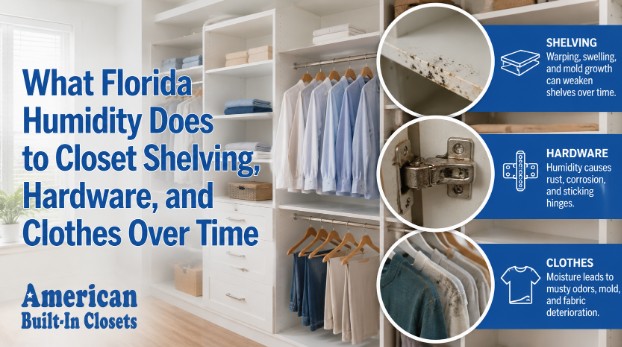
Florida’s average indoor relative humidity ranges from 55% to 75% year-round. That persistent moisture warps closet shelving, corrodes metal hardware, and embeds musty odors into stored clothing — often within 12 to 36 months.
Perry Birman, Founder of American Built-In Closets, has spent nearly 30 years replacing failed closet systems across Broward County. The damage follows a predictable timeline.
Custom-built closets engineered for South Florida’s climate use moisture-resistant substrates, sealed edge banding, and corrosion-proof hardware to prevent every failure on this list.
Key Takeaways
Florida’s indoor humidity (55–75% RH) warps standard particleboard shelving and corrodes uncoated metal hardware within 1 to 3 years.
Musty closet odors in South Florida homes result from moisture trapped in untreated wood substrates and unsealed shelf edges — not from clothing alone.
Moisture-resistant melamine, sealed PVC edge banding, and nickel- or chrome-plated hardware eliminate the three most common humidity-driven closet failures.
American Built-In Closets manufactures every system at its Sunrise, FL, facility using materials specifically selected for South Florida’s climate.
Warped shelves and musty clothes drain your mornings and your wardrobe. American Built-In Closets designs humidity-resistant custom storage for South Florida homes — schedule your free consultation today.
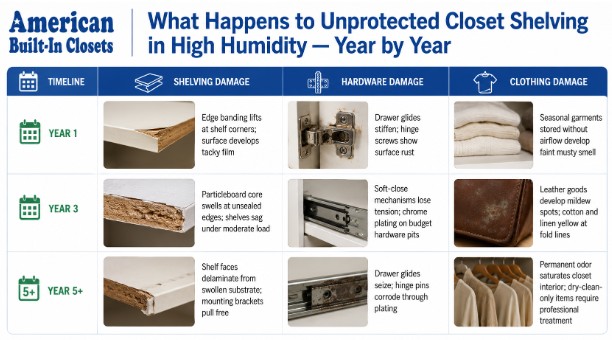
What Happens to Unprotected Closet Shelving in High Humidity — Year by Year
Standard builder-grade closet systems installed in South Florida homes begin showing humidity damage within 12 months. Perry Birman has documented this pattern across hundreds of Broward County closet replacements over nearly 30 years of in-home consultations.
Timeline
Shelving Damage
Hardware Damage
Clothing Damage
Year 1
Edge banding lifts at shelf corners; surface develops a tacky film
Drawer glides stiffen; hinge screws show surface rust
Seasonal garments stored without airflow develop a faint musty smell
Year 3
Particleboard core swells at unsealed edges; shelves sag under moderate load
Soft-close mechanisms lose tension; chrome plating on budget hardware pits
Leather goods develop mildew spots; cotton and linen yellow at fold lines
Year 5+
Shelf faces delaminate from swollen substrate; mounting brackets pull free
Drawer glides seize; hinge pins corrode through plating
Permanent odor saturates closet interior; dry-clean-only items require professional treatment
Most builder-grade shelving uses unsealed particleboard with paper-thin edge tape — a combination that absorbs ambient moisture within weeks of installation in South Florida’s climate.
If you’re ready to get
started, call us now!
Why Does My Closet Smell Musty in South Florida?
Musty closet odor is a moisture problem, not a cleaning problem. The smell originates from mold and mildew colonies growing inside unsealed shelf substrates and along unfinished cabinet backs — not from dirty clothes.
The U.S. Environmental Protection Agency identifies indoor relative humidity above 60% as the threshold for mold growth on organic materials, and South Florida homes routinely exceed that level even with air conditioning running.
Closets without adequate ventilation trap warm, moist air against clothing and shelving surfaces.
Standard particleboard absorbs that moisture into its core, creating a breeding surface for mold spores that release volatile organic compounds — the musty smell homeowners notice when they open the closet door. Proper garment storage in South Florida requires sealed shelving surfaces that block moisture absorption at the substrate level.
Perry Birman identifies three specific failure points that cause musty closets in South Florida homes: unsealed shelf edges that wick moisture into the particleboard core, unfinished closet backs where drywall meets the unconditioned attic or an exterior wall, and overcrowded rod sections that block airflow between garments.
Do Wood Closet Shelves Warp in South Florida?
Solid wood and standard particleboard shelves warp in South Florida because wood fibers absorb moisture unevenly. A shelf exposed to 65% relative humidity on its top surface and 72% underneath — common when shelves sit against an exterior wall — expands at different rates across its thickness. The result is a visible bow that worsens with each rainy season.
Material
Moisture Absorption Rate
Warp Risk in South FL
Recommended Use
Standard particleboard (unsealed)
High — absorbs 8–12% body weight in moisture
Severe — warps within 12–18 months
Not recommended for Florida closets
MDF (medium-density fiberboard)
Moderate — absorbs 5–8%
Moderate — edge swelling is common by year 2
Acceptable with fully sealed edges only
Moisture-resistant particleboard (MR-grade)
Low — absorbs under 3%
Minimal — maintains structural integrity for 10+ years
Recommended for all South FL closet systems
Thermally-fused melamine on MR substrate
Very low — sealed surface blocks penetration
Very low — factory-sealed faces prevent moisture entry
Optimal for South FL — used by American Built-In Closets
American Built-In Closets uses industrial-grade, moisture-resistant particleboard with thermally fused melamine surfaces and PVC edge banding sealed on all four edges.
Perry Birman requires this specification for every custom closet system because sealed substrates eliminate the exposed core material that can cause warping, swelling, and delamination in South Florida’s climate.
How to Protect Clothes from Humidity in a Closet
Protecting clothing from humidity damage requires both material upgrades to the closet system and storage practices that promote consistent airflow around garments.
Sealed closet substrates prevent moisture from migrating from shelving into folded garments.
Thermally fused melamine (TFM) is a decorative resin layer bonded directly to the substrate under heat and pressure, creating a non-porous moisture barrier between the shelf core and the fabric. PVC edge banding — not paper edge tape — ensures that the barrier extends to every exposed edge where moisture entry is most aggressive.
Proper rod spacing plays an equally important role in garment protection. Perry Birman recommends a minimum of 1 inch between hangers for everyday garments and 2 inches for suits, blazers, and coats.
Walk-in closet designs with double-hang sections maximize rod capacity while maintaining the airflow gaps that prevent mildew transfer between garments.
Cedar accessories — drawer liners and hanging panels — absorb ambient moisture and release natural oils that repel moth larvae and mildew spores.
American Built-In Closets offers cedar-lined drawer inserts as a standard upgrade for all custom closet designs in Broward and Palm Beach Counties.
Humidity is aging your closet system and your wardrobe every day it goes unaddressed. American Built-In Closets builds precision-fit storage engineered for South Florida’s climate — request your free 3D design consultation.
If you’re ready to get
started, call us now!
Best Closet Materials for Florida Humidity
The best closet materials for Florida humidity share three properties: low moisture absorption, sealed surfaces on all faces and edges, and corrosion-resistant hardware. Perry Birman selects every material in an American Built-In Closets system based on these criteria.
Shelving substrate should be moisture-resistant (MR-grade) particleboard — not standard particleboard or MDF.
MR-grade particleboard is an engineered wood panel that uses moisture-resistant resin in its manufacturing process, reducing water absorption to under 3% of its body weight, compared to 8–12% for standard boards.
Surface finish should be thermally fused melamine applied to both faces of every shelf and panel — not just the visible side. Single-sided lamination leaves the back face exposed to moisture absorption, causing uneven expansion that leads to warping in Fort Lauderdale condos and Broward County homes.
Edge banding should be PVC (polyvinyl chloride), not paper or polyester tape. PVC edge banding resists moisture and peeling and maintains its bond at temperatures up to 150°F — critical in closets that share walls with sun-exposed exterior surfaces.
Hardware — hinges, drawer glides, and pull-out mechanisms — should be nickel-plated or chrome-plated steel.
Uncoated steel hardware corrodes in South Florida closets within 18 to 24 months. American Built-In Closets specifies soft-close, full-extension drawer glides with nickel-plated housings on every built-in closet design.
How American Built-In Closet Engineers Store for South Florida’s Climate
Every closet system American Built-In Closets manufactures in its Sunrise, FL, facility follows a humidity-specific engineering standard that Perry Birman developed over nearly 30 years of South Florida installations.
The process starts with a free in-home consultation where Perry or a senior designer measures the space, evaluates wall conditions (exterior vs. interior, insulation quality, ventilation access), and identifies humidity-specific risk factors unique to that home.
The design team then produces a 3D rendering showing exact shelf placement, rod configuration, and airflow clearances — before any material is cut.
Manufacturing uses MR-grade particleboard with thermally fused melamine on both faces, PVC edge banding sealed on all four edges, and nickel-plated soft-close hardware throughout the system.
Every component is custom-built to the room’s exact dimensions — eliminating the gaps between shelving and walls that trap dead air and breed moisture in standard modular systems.
The 20-year warranty covers shelving integrity, hardware function, and finish durability — because materials engineered for Florida’s climate should perform for decades, not years.
Over 121 five-star Google reviews from Broward and Palm Beach County homeowners confirm that humidity-resistant construction delivers long-term results that builder-grade systems cannot match.
Contact Us Today For An Appointment
Frequently Asked Questions
Why does my closet smell musty in Florida?
Musty closet odor results from mold growing inside unsealed shelf substrates exposed to Florida’s 55–75% indoor relative humidity. The smell originates in the shelving material, not stored clothing. Sealed melamine surfaces and PVC edge banding eliminate the moisture entry points that cause the odor.
Do closets get mold in humid climates?
Closets in humid climates develop mold when indoor relative humidity exceeds 60%, and shelving materials lack sealed surfaces. Standard particleboard and unfinished wood absorb ambient moisture, creating organic surfaces where mold colonies establish. Moisture-resistant substrates with thermally fused melamine prevent mold colonization on closet components.
What is the best closet material for Florida humidity?
Moisture-resistant particleboard with thermally fused melamine on both faces and PVC edge banding on all four edges performs best in Florida’s climate. American Built-In Closets uses this combination on every system manufactured at its Sunrise, FL facility, limiting moisture absorption to under 3% of the substrate’s weight.
How do I protect clothes from humidity in my closet?
Protecting clothing requires sealed closet surfaces to prevent moisture migration from shelves into fabric, a minimum of 1 inch between hangers to improve airflow, and cedar drawer liners that absorb ambient moisture. Humidity-resistant closet materials prevent moisture from reaching stored garments at the substrate level.
Do wood closet shelves warp in South Florida?
Standard wood and particleboard shelves warp in South Florida because wood fibers absorb moisture unevenly across the shelf’s thickness, causing differential expansion. MR-grade particleboard with sealed melamine surfaces resists this absorption, maintaining structural integrity for 10 years or longer under South Florida humidity.
What happens to closet shelves in high humidity?
High humidity causes unsealed particleboard to absorb moisture, producing edge swelling within 12 months, visible shelf sag by year 3, and face delamination by year 5. Edge banding lifts, hardware loosens in swollen substrate, and the system requires full replacement well before its expected lifespan.
How often should I replace closet shelving in Florida?
Builder-grade closet shelving in South Florida typically requires replacement every 5 to 7 years due to humidity damage. Custom systems built with MR-grade substrates, thermally fused melamine, and sealed PVC edge banding maintain structural and cosmetic integrity for 15 to 20 years or longer.
Does air conditioning prevent closet humidity damage?
Air conditioning reduces indoor humidity but does not eliminate it in South Florida. Homes commonly register 55–65% relative humidity even with HVAC running continuously. Closet interiors against exterior walls often exceed ambient room humidity by 5–10 percentage points, keeping moisture above safe thresholds for organic materials.
Can I add ventilation to fix a musty closet?
Adding ventilation circulates air but does not address the root cause. Unsealed shelf substrates continue absorbing moisture regardless of airflow improvements. Effective remediation requires replacing porous shelving materials with moisture-resistant, sealed alternatives and addressing unfinished surfaces where drywall meets unconditioned wall or attic space.
Are custom closets worth it in Florida specifically because of humidity?
Custom closets built with humidity-resistant materials protect stored clothing, maintain structural integrity over 15–20 years, and eliminate the recurring replacement costs that builder-grade systems incur every 5–7 years. American Built-In Closets prices its systems 30–40% below major franchise competitors, significantly reducing the cost gap.
Every season without humidity-resistant shelving costs you warped surfaces, corroded hardware, and clothing you cannot recover. Call Perry Birman and the team at American Built-In Closets at 954-748-0800 for a free in-home design consultation — nearly 30 years of South Florida craftsmanship, backed by 121+ five-star reviews.
Founder, American Built-In Closets · Custom Closet Designer · Storage Solutions Specialist · Space Optimization Expert
Perry Birman is the founder of American Built-In Closets, a South Florida custom closet and storage company he established in 1996. With nearly three decades of experience in custom storage design, furniture manufacturing, and residential space optimization, Perry has helped homeowners throughout Miami-Dade, Broward, and Palm Beach counties create functional, customized organization systems tailored to their homes and lifestyles.
Drawing on a hands-on background in furniture manufacturing and production, Perry has extensive expertise in materials selection, fabrication processes, structural design, cabinetry construction, and custom-built storage systems. He has overseen the design, manufacturing, and installation of thousands of custom closets, garage storage systems, home offices, pantries, wall units, and built-in organization solutions throughout South Florida.
As founder of American Built-In Closets, Perry oversees design standards, manufacturing operations, product quality, and project development. His work focuses on maximizing usable space while maintaining durability, craftsmanship, functionality, and long-term value for homeowners.
Perry regularly shares insights on custom closet design, home organization, space optimization, built-in storage solutions, cabinetry construction, and residential storage trends based on nearly 30 years of real-world experience serving South Florida homeowners.
Credentials Snapshot
Founder, American Built-In Closets (1996–Present)
Nearly 30 Years of Custom Storage & Closet Design Experience
Expertise in Furniture Manufacturing & Cabinet Construction
Specialization: Custom Closets, Garage Storage, Home Offices, Pantries & Built-In Organization Systems
Service Area: Miami-Dade, Broward & Palm Beach Counties, Florida