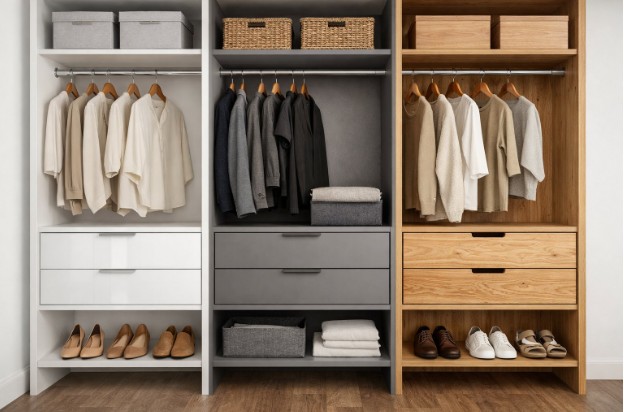
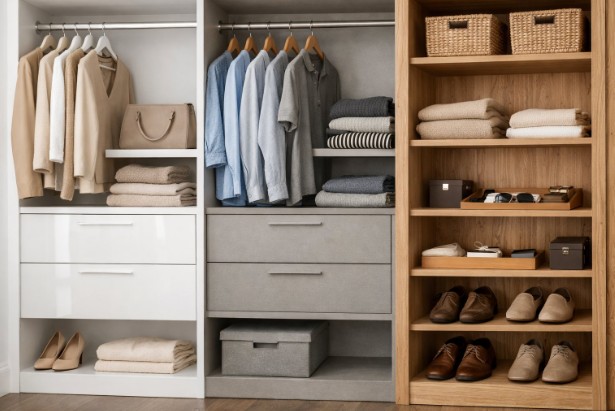
Choosing the right material for your custom closet affects its longevity, appearance, and overall cost. The three most common picks? Melamine, MDF, and plywood.
Each one brings something different to the table, and those differences actually matter when you’re living with them every day.
Melamine usually offers the best balance of durability, moisture resistance, and price. Plywood is the heavy-duty option, while MDF is a good choice if you want a painted finish.
Your choice depends on your budget, climate, and the weight you plan to store on those shelves. Understanding what these materials actually are makes it way easier to compare them.
This guide breaks down the pros and cons of different closet materials so you can make a call that feels right.
Key Takeaways
Melamine is affordable, scratch-resistant, and moisture-resistant—great for most closets.
Plywood costs more but supports heavy loads and long shelves without issue.
Your local climate and storage needs matter more than just the sticker price.
Which Closet Material Is “Best” for Most Homes?
Melamine is the go-to for most homeowners building custom closets. It strikes the right balance of price, performance, and no-fuss cleaning.
You get a smooth, finished surface that resists moisture and stains. Melamine boards show up in all sorts of colors and styles, so you don’t have to bother with paint or sealant. The best materials for custom closets often include melamine for its practical perks and style options.
Here’s a quick side-by-side of the three big contenders:
Material
Best for
Watch-outs
Melamine/TFL/HPL over-engineered core
Low-maintenance, clean look, consistent finishes
Edge chipping; core swelling if unsealed
MDF
Painted panels/doors, smooth machining
Swells with humidity/water; needs sealing
Plywood
Strength, screw-holding, long spans
Cost: edge finishing required
Melamine costs less than solid wood but outperforms basic MDF. You won’t have to deal with warping like you might with MDF, especially if you pile on the weight.
This material handles humid areas like bedroom closets without issue. You can wipe it down without worrying about water damage.
Your custom closets stay looking sharp for years with minimal upkeep. If you need shelves that can handle heavy loads or long spans, plywood is the smart choice.
MDF shines if you’re after a painted look. But for most closets, melamine hits the sweet spot.
American Built-In Closets helps Broward homeowners choose closet materials that resist humidity, wear, and sagging—starting with a free design consultation. Schedule an appointment.
If you’re ready to get
started, call us now!
What These Materials Actually Are (So You’re Comparing Apples to Apples)
Before you pick a closet material, it helps to know what you’re actually looking at. These options aren’t all cut from the same cloth—literally.
Melamine isn’t just one thing. Manufacturers take MDF or plywood and cover it with melamine resin. That resin forms a hard, smooth, finished surface.
MDF stands for medium-density fiberboard. They grind wood into fibers, add glue, and press the mixture together under heat. You end up with a dense, smooth board—no wood grain at all.
Plywood is made by gluing thin wood veneer sheets in layers. Each layer runs in a different direction, so the board gets stronger. You can spot the layers by peeking at the edges.
Particleboard is made from larger wood chips and sawdust, pressed together with glue. It’s kind of like MDF’s chunkier cousin.
Here’s where folks get tripped up: when someone says “melamine board,” they usually mean MDF or particleboard with a melamine layer on top. The core and the surface are two separate things. Your closet might have MDF cores with melamine faces, plywood shelves with melamine, or even just bare plywood with a different finish. Knowing this helps you compare apples to apples when you’re shopping around.
Durability Over Time: Sagging Shelves, Loose Hardware, and Long Spans
When you want your closet to last, shelf strength is a big deal—especially if you’re stacking up heavy stuff for years. Each material handles weight and time differently.
MDF Shelves and Sagging Issues
MDF shelves often sag over time when overloaded or in high humidity. Over time, MDF loses strength and becomes brittle, which isn’t ideal if you need to store heavy loads.
Material Performance Comparison
Material
Sag Resistance
Best Span Length
Hardware Holding
MDF
Poor
Under 24 inches
Weak
Plywood
Good
Up to 36 inches
Strong
Melamine
Excellent
Up to 36 inches
Strong
Solid Wood
Excellent
Up to 48 inches
Excellent
Long Span Considerations
If your shelves exceed 36 inches, you’ll need extra support. Melamine holds its shape better than MDF, making it a safer choice for long-lasting shelves and drawers.
Hardware and Fasteners
How well your closet holds screws and fasteners matters in the long run. MDF just doesn’t grip hardware well, especially if you have to move or re-install anything. Plywood and melamine do a much better job of keeping everything tight and secure.
Moisture and Humidity: The South Florida Reality (Broward County)
South Florida’s humidity hovers around 70-75% year-round. That kind of moisture is rough on closet materials. If you skip edge banding, exposed edges absorb water and begin to deteriorate from the inside out.
The “Edge Banding” Rule
Edge banding is a protective strip that covers the exposed edges of engineered wood products such as MDF and particleboard. In Broward County’s humid weather, unprotected edges will suck up moisture, swell, and eventually fail.
You need edge banding on every exposed edge—shelves, drawer fronts, vertical panels, and anywhere a cut leaves the core showing.
Critical areas that need edge banding:
All horizontal shelf edges
Top and bottom of vertical dividers
Drawer openings
Any custom cuts made during installation
Particleboard is especially water-absorbent if left bare. Even MDF, which holds up better than particleboard, still needs full edge protection in South Florida.
Melamine-coated boards offer some defense, but the edges still need sealing.
Edge banding isn’t just a nice extra—it’s a must in this climate. Skip it, and you’ll probably see damage before the year is out.
Surface Wear: Scratch, Impact, and Stain Resistance (Where HPL vs TFL Matters)
High-pressure laminate (HPL) resists scratches and bumps better than thermally fused laminate (TFL). The reason? HPL is pressed at a higher pressure, so it’s tougher.
Where to Use Tougher Surfaces
Apply HPL to closet surfaces that get a lot of use—drawer fronts, shelves at waist height, and areas near the closet entrance. Those places take the most abuse.
TFL is fine for low-traffic areas where scratches and dings aren’t a big worry. Think upper shelves, cabinet sides, and closet backs. These don’t get much wear, so you can save a little cash there.
Your choice really does affect how long your closet looks good. HPL keeps its looks in busy spots, while TFL is a budget-friendly pick for out-of-the-way areas.
Knowing the difference in impact resistance helps you put the right material in the right place.
Both HPL and TFL resist stains pretty well—they use similar surface papers. Spills wipe up easily, so you don’t have to panic if something drips or splatters.
Aesthetics and Finish Options: Matte White, Woodgrains, and Painted Looks
Each cabinet material opens up different finish options for your custom closet. The finish you pick shapes the vibe and feel of your space.
Melamine cabinets come with a factory-applied finish fused to the particleboard core. You’ll find melamine in a wide range of colors and patterns—matte white, woodgrain textures, and solid shades are favorites.
The finish comes pre-applied, so you don’t need to paint or stain melamine. It’s a straightforward, low-fuss choice.
MDF is well-suited to paint due to its smooth, consistent surface. You can get glossy, matte, or woodgrain finishes with painted MDF.
Many homeowners choose MDF for painted finishes in white, gray, or navy. Since it has no grain, it gives you a crisp, modern look every time.
Plywood offers real-wood veneer options with authentic grain patterns. You can stain plywood to highlight the wood’s character or paint it for a different style.
Stained plywood offers warmth and personality that laminated materials just can’t match.
Your choice really comes down to whether you’re after a natural wood vibe, a solid painted look, or something super low-maintenance. Matte white remains the most popular choice for its clean, timeless style.
Looking for a clear recommendation on melamine, MDF, or plywood? Our designers review your storage load and finishes, and American Built-In Closets shows options in 3D. Contact us.
If you’re ready to get
started, call us now!
Cleaning and Maintenance: What Stays Looking New With Minimal Effort?
Melamine is the easiest material to keep clean in your custom closet. Just wipe melamine surfaces with a damp cloth and a little mild soap to remove dust or spills.
The plastic coating resists stains and moisture, so you won’t need specialized cleaners or treatments. It’s a relief if you don’t want to fuss over maintenance.
MDF needs a gentler touch. Because it’s made from wood residuals, it can absorb moisture if not properly sealed.
Use a slightly damp cloth, not a wet one, and avoid harsh chemicals. Too much water or the wrong cleaner can damage the finish or cause swelling.
Maintenance comparison:
Material
Cleaning Method
Water Resistance
Special Care Needed
Melamine
Damp cloth + mild soap
Excellent
None
MDF
Slightly damp cloth only
Poor (if unsealed)
Avoid excess moisture
Plywood
Damp cloth + wood cleaner
Good (if sealed)
Periodic sealing recommended
Plywood sits somewhere in the middle for maintenance. Clean and seal the plywood with a damp cloth and the appropriate wood cleaner.
It’s smart to inspect the finish annually and reapply sealant as needed. That way, you’ll protect against moisture damage.
Both melamine and MDF with a melamine coating offer affordable, low-maintenance options if you’re busy.
Melamine surfaces don’t need polishing, waxing, or refinishing, so they’re perfect if you want a closet that just stays looking good.
Indoor Air Quality: What to Know About Formaldehyde Compliance
When you’re picking materials for your custom closet, don’t overlook formaldehyde emissions and indoor air quality. This chemical shows up in the adhesives used to make pressed wood products.
Common Sources in Closet Materials:
Particleboard is found in shelving and cabinets
Medium-density fiberboard (MDF) in drawer fronts and cabinet surfaces
Hardwood plywood paneling for decorative details
Formaldehyde is a colorless gas with a strong odor that can affect your home’s indoor air quality. Closet materials may release this chemical over time, depending on your home’s temperature, humidity, and ventilation.
Look for products that meet today’s emission standards. Low-emission composite wood materials carry third-party certifications that help reduce your exposure to chemicals.
These products aim to reduce the amount of formaldehyde that ends up in your home.
What to Look For:
CARB2 certification on the label
NAF (No Added Formaldehyde) or ULEF (Ultra-Low Emitting Formaldehyde) designations
Any third-party certifications for low emissions
Newly installed cabinets and furniture may initially have higher formaldehyde levels. Good ventilation during and after installation helps clear the air faster.
Decision Guide: Pick Your Material in 60 Seconds
If you want the most affordable option, go with MDF. It’s cheaper than the others and covers basic closet needs without fuss.
If you need water-resistant surfaces, melamine is your best friend. The protective coating blocks moisture, making it a solid choice for humid spaces.
If you’re building heavy-duty storage, plywood’s your answer. It supports more weight and withstands stress better than MDF or melamine.
Here’s a quick comparison to help you decide:
Your Priority
Best Material
Why
Lowest cost
MDF
Most budget-friendly option
Moisture protection
Melamine
Water-resistant coating
Maximum strength
Plywood
Handles heavy loads
Easy maintenance
Melamine
Wipes clean easily
Paint-ready surface
MDF
Smooth finish accepts paint well
If you plan to paint your closet, MDF gives you the smoothest base. No visible grain, just a clean surface for any color you want.
If you want minimal upkeep, melamine barely needs any effort—just a quick wipe, and you’re done.
If your budget allows flexibility, why not mix materials for custom closets? Use plywood for heavy-duty shelves and melamine for drawers or doors. It’s a good way to balance cost, performance, and aesthetics.
If you live in a humid climate, it’s best to avoid standard MDF. It doesn’t like moisture and will eventually swell or lose its shape.
What We Use at American Built-In Closets (and Why It Works Here)
At American Built-In Closets, we stick with melamine for our custom closet systems. It just makes sense for us—this material lets us deliver sturdy storage for all kinds of budgets and tastes.
Why Melamine Works for Our Clients:
Durability – Melamine resists scratches, moisture, and daily wear better than many other options.
Cost-effective – You get a solid, good-looking closet without the cost of solid wood.
Easy maintenance – Wipe it down and you’re set. No fuss.
Style variety – There are plenty of colors and finishes to fit whatever look you want at home.
We aim to make the most of your space with smart features such as pull-out racks and built-in drawers. Melamine handles these extras well. It doesn’t add much weight or cost, either.
Our systems shine in walk-in and reach-in closets. You can count on them to hold up to daily use—hanging clothes, stacking shoes, or tucking away accessories—without sagging or warping over time.
People choose us because we combine practical materials with design that makes sense. We’re not here to push the priciest thing. We want your storage to fit your life, not the other way around.
The closets we put in tend to last for years, and you won’t have to baby them. No need for fancy cleaners or worrying about refinishing—just use them and enjoy.
Choose materials that stay straight, clean, and durable in Florida humidity—then get professional installation and long-term support with American Built-In Closets. Schedule an appointment.
Contact Us Today For An Appointment
Frequently Asked Questions
Is melamine good for custom closets?
Melamine closets can be an excellent choice because their surfaces are durable, low-maintenance, and resistant to everyday scuffs. Performance depends on the core and sealed edges—in humid climates, moisture-resistant laminated panels are often preferred.
What’s the difference between “melamine,” TFL, and HPL?
“Melamine” often refers to a resin-based decorative surface. TFL fuses that surface directly to a substrate, while HPL is typically tougher in terms of scratch, wear, and impact resistance. Use HPL in high-wear closet zones.
Is MDF a bad material for closets?
MDF isn’t “bad,” but it’s more vulnerable to moisture and can swell when exposed to humidity or water. Once MDF or particleboard swells beyond its original dimensions, full recovery isn’t guaranteed—so proper sealing and ventilation are essential.
Is plywood better than MDF for closet shelves?
Plywood is generally stronger and holds fasteners well, making it a solid choice for heavier loads or longer spans. MDF can be used for painted finishes, but it typically requires more moisture protection and careful span support.
What material is best for closets in South Florida’s humidity?
In humid areas, moisture-resistant laminated panels with sealed edges are often the safest bet for long-term performance. American Built-In Closets uses ¾” TFL or HPL and notes that these materials are selected for South Florida conditions.
Which closet material is easiest to clean and maintain?
Laminate-faced panels (melamine/TFL/HPL) are typically easiest to maintain because they wipe clean and resist staining. Painted MDF is more prone to scuffs, and wood/plywood finishes may require gentler cleaners and more care.
Are MDF, plywood, and melamine-based panels “safe” for indoor air quality?
Composite wood products like MDF, particleboard, and hardwood plywood are regulated for formaldehyde emissions in the U.S. under EPA TSCA Title VI. Ask whether panels and finished goods are TSCA Title VI compliant.