The One Closet Upgrade Every South Florida Client Asked for in 2026
By Perry BirmanFounder, American Built-In Closets · Custom Closet Designer, Storage Solutions Specialist & Space Optimization Expert|Originally published: July 2026 | Updated: August 2026
Every custom closet project Perry Birman designed at American Built-In Closets in 2026 included the same upgrade request — integrated LED lighting. Not pull-out drawers, not shoe racks, not a closet island.
Lighting. Perry Birman, Founder of American Built-In Closets, has tracked feature requests across his Broward and Palm Beach County project log for nearly 30 years, and no single accessory has reached a 100% request rate until this year.
The reason is simple: every other closet upgrade becomes invisible in a dark closet.
Key Takeaways
Integrated LED lighting is the most requested custom closet upgrade in American Built-In Closets’ 2026 project log — appearing in every single design consultation across Broward and Palm Beach County.
LED closet lighting solves three problems simultaneously: garment misidentification caused by poor color rendering, wasted time searching in the shadows, and safety hazards in low-visibility floor areas.
Motion-activated LED strips with a color rendering index (CRI) of 90+ and a color temperature of 3500–4000K deliver the most accurate visibility of garments in enclosed closet environments.
American Built-In Closets integrates LED lighting positions into every 3D design rendering before manufacturing begins at its Sunrise, FL facility.
Dark closets cost you time, outfit accuracy, and garments you forget you own. American Built-In Closets designs custom systems with integrated lighting engineered for South Florida homes — schedule your free consultation today.
Why Closet Lighting Became the Most Popular Feature in 2026
Closet lighting became the most popular custom closet feature in 2026 because homeowners stopped treating closets as storage rooms and started treating them as the first functional space they use every morning.
Perry Birman attributes the shift to three converging factors he observed across his South Florida client base this year.
The first factor is the boutique-closet influence. Social media, design platforms, and home renovation content have normalized the idea that a closet should look and feel like a curated retail space — and retail spaces are built around lighting.
Homeowners now arrive at consultations with reference images showing illuminated shoe displays, backlit hanging sections, and LED-lined drawer interiors. The expectation has moved from “a light in the closet” to “a lighting system designed around the closet.”
The second factor is aging-eye awareness. South Florida’s retiree population — a significant portion of American Built-In Closets’ client base in Pompano Beach, Boca Raton, Coral Springs, and Pembroke Pines — needs brighter, higher-CRI lighting to distinguish between similar garment colors.
Navy versus black, charcoal versus dark gray, brown versus burgundy — these distinctions disappear under a single 60-watt overhead bulb.
The third factor is closet depth. Walk-in closets in Broward County homes commonly extend 6 to 10 feet from the door, leaving the back wall and side corners permanently in shadow under a ceiling-mounted fixture alone.
LED strip lighting mounted under shelves and inside drawer interiors solves the depth problem by distributing light across every vertical surface where garments actually hang.
If you’re ready to get
started, call us now!
What Problem Does Integrated Closet Lighting Actually Solve?
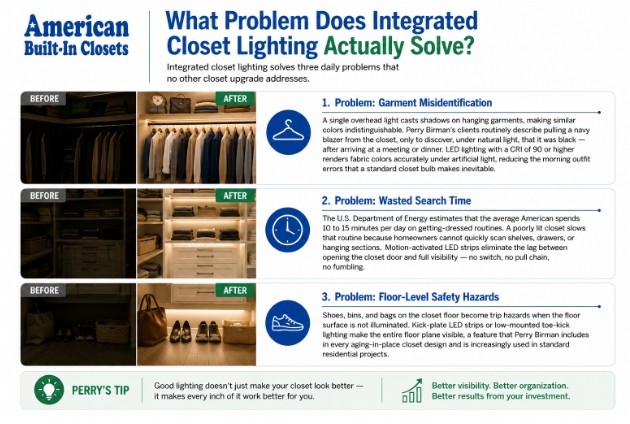
Integrated closet lighting solves three daily problems that no other closet upgrade addresses.
Problem 1: Garment misidentification. A single overhead light casts shadows on hanging garments, making similar colors indistinguishable.
Perry Birman’s clients routinely describe pulling a navy blazer from the closet, only to discover, under natural light, that it was black — after arriving at a meeting or dinner. LED lighting with a CRI of 90 or higher renders fabric colors accurately under artificial light, reducing the morning outfit errors that a standard closet bulb makes inevitable.
Problem 2: Wasted search time. The U.S. Department of Energy estimates that the average American spends 10 to 15 minutes per day on getting-dressed routines. A poorly lit closet slows that routine because homeowners cannot quickly scan shelves, drawers, or hanging sections.
Motion-activated LED strips eliminate the lag between opening the closet door and full visibility — no switch, no pull chain, no fumbling.
Problem 3: Floor-level safety hazards. Shoes, bins, and bags on the closet floor become trip hazards when the floor surface is not illuminated.
Kick-plate LED strips or low-mounted toe-kick lighting make the entire floor plane visible, a feature that Perry Birman includes in every aging-in-place closet design and is increasingly used in standard residential projects.
Problem
Without Integrated Lighting
With Integrated LED Lighting
Color accuracy
Navy/black misidentification under a single overhead bulb
CRI 90+ LEDs render true garment color at every shelf level
Search time
2–4 extra minutes per morning scanning dark corners and drawers
Motion-activated strips provide full visibility in under 1 second
Floor safety
Loose items are invisible below the rod height
Toe-kick lighting illuminates the entire floor plane
Is Closet Lighting Worth It? Cost vs. Daily Impact
Closet lighting is the single highest-impact-per-dollar upgrade in a custom closet system. Perry Birman presents this data to every client during the free design consultation.
The closet system itself — shelving, drawers, rods, hardware — typically ranges from $2,000 to $8,000 depending on closet size and accessory selections.
Integrated LED lighting adds $150 to $500 to the system cost when incorporated into the 3D rendering prior to manufacturing. This represents 3–8% of the total project cost for a feature that affects every single use of the closet, twice per day, 365 days per year.
Lighting Tier
What’s Included
Added Cost
Best For
Basic
Motion-activated puck lights on battery (2–4 units)
$50–$100
Reach-in closets; renters; no electrician needed
Standard
Hardwired LED strips under shelves + motion sensor
$150–$300
Walk-in closets; most residential projects
Premium
Hardwired LED strips under shelves, inside drawers, toe-kick lighting, dimmer control, 90+ CRI
$300–$500
Large walk-ins; aging-in-place; boutique-style closets
The premium tier requires a licensed electrician for hardwired installation — a separate cost of $150 to $800+ depending on wiring access, as covered in the hidden costs of custom closets.
American Built-In Closets coordinates lighting placement with the homeowner’s electrician before manufacturing so wiring channels align with the system’s shelf positions and drawer tower locations.
Stop choosing outfits in the dark and only to discover mismatches under natural light. American Built-In Closets integrates precision lighting into every custom system — request your free 3D design consultation today.
If you’re ready to get
started, call us now!
What Closet Types Benefit Most from Integrated Lighting?
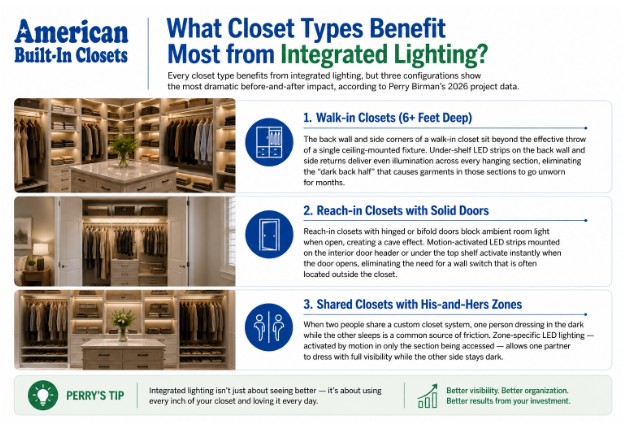
Every closet type benefits from integrated lighting, but three configurations show the most dramatic before-and-after impact, according to Perry Birman’s 2026 project data.
Walk-in closets (6+ feet deep). The back wall and side corners of a walk-in closet sit beyond the effective throw of a single ceiling-mounted fixture. Under-shelf LED strips on the back wall and side returns deliver even illumination across every hanging section, eliminating the “dark back half” that causes garments in those sections to go unworn for months.
Reach-in closets with solid doors. Reach-in closets with hinged or bifold doors block ambient room light when open, creating a cave effect. Motion-activated LED strips mounted on the interior door header or under the top shelf activate instantly when the door opens, eliminating the need for a wall switch that is often located outside the closet.
Shared closets with his-and-hers zones. When two people share a custom closet system, one person dressing in the dark while the other sleeps is a common source of friction. Zone-specific LED lighting — activated by motion in only the section being accessed — allows one partner to dress with full visibility while the other side stays dark.
What Do Custom Closet Designers Recommend Most in 2026?
Custom closet designers across the industry recommend LED lighting as the single most impactful upgrade in 2026, and the consensus aligns with Perry Birman’s project data.
The International Association of Lighting Designers has documented a broader residential shift toward task-specific lighting design — and closets are among the most underlit task environments in the average home.
Perry Birman recommends a specific lighting specification for every American Built-In Closets project: LED strips with a CRI of 90 or higher, a color temperature between 3500K and 4000K (neutral white—accurate color rendering without the clinical feel of cool white), and a motion-activated trigger with a 3-minute auto-off timer.
This specification balances garment visibility, energy efficiency, and the warm aesthetic that South Florida homeowners prefer.
The placement matters as much as the specification. Perry Birman positions LED strips at the front edge of every shelf (not the back), so light falls on garment faces rather than pooling on the shelf surface behind them. Drawer-interior LEDs activate when the drawer opens and shut when it closes.
Toe-kick strips run the full width of floor-mounted cabinetry. Every lighting position is mapped in the 3D design rendering and approved by the homeowner before a single panel is cut.
Contact Us Today For An Appointment
Frequently Asked Questions
What is the most popular closet feature right now?
Integrated LED lighting is the most requested custom closet feature in 2026. Industry-wide, designers report lighting upgrades appearing in the majority of new projects, and American Built-In Closets recorded a 100% request rate across its Broward and Palm Beach County consultations this year.
What closet upgrades are worth it in 2026?
Integrated LED lighting delivers the highest impact per dollar spent because it affects every use of the closet — twice daily, 365 days per year. At $150 to $500 added to the system cost, lighting represents 3–8% of total project investment while improving color accuracy, search speed, and safety.
What should I add to my custom closet?
Start with integrated LED lighting, which makes every other feature in the closet more functional. After lighting, the highest-value additions are full-extension soft-close drawers, pull-down rods for upper storage access, and dedicated accessory zones for shoes, jewelry, or hobby gear.
Is closet lighting worth it?
Closet lighting is worth the investment because it solves daily garment misidentification, reduces morning search time by eliminating dark zones, and improves floor-level safety. LED strips rated for 50,000 hours cost $150 to $500 and require no replacement for approximately 13 years of daily use.
What do custom closet designers recommend most?
Custom closet designers recommend integrated LED lighting with a CRI of 90 or higher and a color temperature between 3500K and 4000K for accurate garment color rendering. Motion activation, under-shelf strip placement, and drawer-interior LEDs are the most commonly specified configurations.
Best closet upgrade for the money?
Integrated LED lighting ranks as the best closet upgrade for the money because it costs 3–8% of the total system price while improving every daily interaction with the closet. No other single accessory — drawers, valet rods, shoe racks — affects both functionality and safety at that cost ratio.
What are the closet trends for 2026?
The dominant 2026 closet trend is lighting-forward design, where LED integration is treated as a structural element rather than an accessory. Warm neutral finishes, boutique-style displays, motion-activated technology, and dedicated zones for charging stations and hobby storage round out the year’s top design directions.
What is the most requested closet accessory?
Motion-activated LED strip lighting is the most requested closet accessory in 2026. It outpaces pull-out drawers, shoe racks, jewelry inserts, and valet rods in American Built-In Closets’ project data because it makes every other accessory in the system visible and functional.
How much does closet LED lighting cost?
Closet LED lighting costs $50 to $100 for battery-operated puck lights, $150 to $300 for hardwired under-shelf LED strips with motion sensors, and $300 to $500 for premium systems including drawer-interior LEDs, toe-kick lighting, and dimmer controls. Electrician costs for hardwired installation run separately.
Can LED lights be added to an existing closet?
Battery-operated and adhesive-backed LED strips can be added to existing closets without modification. Hardwired LED integration delivers superior performance but requires a licensed electrician and is most cost-effective when designed into a new custom closet system rather than retrofitted.
Every upgrade you invest in disappears in a dark closet. Call Perry Birman at American Built-In Closets at 954-748-0800 for a free in-home design consultation.
Founder, American Built-In Closets · Custom Closet Designer · Storage Solutions Specialist · Space Optimization Expert
Perry Birman is the founder of American Built-In Closets, a South Florida custom closet and storage company he established in 1996. With nearly three decades of experience in custom storage design, furniture manufacturing, and residential space optimization, Perry has helped homeowners throughout Miami-Dade, Broward, and Palm Beach counties create functional, customized organization systems tailored to their homes and lifestyles.
Drawing on a hands-on background in furniture manufacturing and production, Perry has extensive expertise in materials selection, fabrication processes, structural design, cabinetry construction, and custom-built storage systems. He has overseen the design, manufacturing, and installation of thousands of custom closets, garage storage systems, home offices, pantries, wall units, and built-in organization solutions throughout South Florida.
As founder of American Built-In Closets, Perry oversees design standards, manufacturing operations, product quality, and project development. His work focuses on maximizing usable space while maintaining durability, craftsmanship, functionality, and long-term value for homeowners.
Perry regularly shares insights on custom closet design, home organization, space optimization, built-in storage solutions, cabinetry construction, and residential storage trends based on nearly 30 years of real-world experience serving South Florida homeowners.
Credentials Snapshot
Founder, American Built-In Closets (1996–Present)
Nearly 30 Years of Custom Storage & Closet Design Experience
Expertise in Furniture Manufacturing & Cabinet Construction
Specialization: Custom Closets, Garage Storage, Home Offices, Pantries & Built-In Organization Systems
Service Area: Miami-Dade, Broward & Palm Beach Counties, Florida