Humidity-Resistant Closet Materials in South Florida: What Holds Up and What Fails
By Perry BirmanFounder, American Built-In Closets · Custom Closet Designer, Storage Solutions Specialist & Space Optimization Expert|Originally published: May 2026
South Florida closet materials fail faster than materials in any other region of the continental United States because Broward County’s average relative humidity regularly exceeds 70 percent year-round, with coastal areas reaching 80 to 85 percent during summer months, according to NOAA Southeast Florida climate normals.
The material your closet designer specifies at the fabrication stage determines whether your system lasts five years or twenty, not how it looks on installation day.
Key Takeaways
Broward County’s relative humidity regularly exceeds 70 percent year-round, causing untreated MDF and standard particleboard to begin swelling at fastener points and cut edges within 12 to 18 months of installation in non-climate-controlled spaces.
Plywood is the most humidity-resistant structural substrate for South Florida closets because cross-laminated wood veneers resist moisture-driven expansion across grain directions simultaneously, unlike single-direction fiber composites.
A moisture-resistant substrate is a panel material engineered to limit water absorption and dimensional change under sustained elevated humidity — the correct specification for any closet component in Broward County that contacts an exterior wall or sits in a non-climate-controlled garage or laundry space.
American Built-In Closets fabricates every project at its Lauderdale Lakes facility and selects substrate materials based on the specific room’s humidity profile and proximity to exterior walls, so each component receives a coastal-climate specification rather than a standardized national product list.
Watching your closet shelves bow, or your drawer faces gap after just a few years? American Built-In Closets builds every system with materials suited for South Florida humidity — stop replacing and start keeping.
How Does Humidity Damage Closet Materials in South Florida?
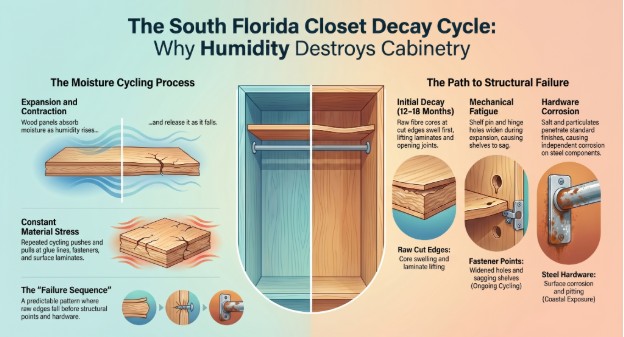
Humidity damages closet materials in South Florida through a process called moisture cycling — the repeated expansion and contraction of wood-based panels as ambient relative humidity rises and falls throughout the day, season, and year.
Wood-based panel products absorb moisture from the air when humidity rises and release it when humidity drops, and each moisture cycle pushes and pulls at glue lines, fastener holes, edge banding, and surface laminates until the material fails structurally or cosmetically.
The specific failure sequence in South Florida closets follows a predictable pattern. Unprotected cut edges absorb moisture first because the raw fiber core is fully exposed.
Swelling at cut edges lifts surface laminates and opens gaps at joints within 12 to 18 months in non-climate-controlled spaces. Fastener points — shelf pin holes, cam lock recesses, hinge mounting holes — widen as the surrounding material expands and contracts, causing shelves to sag and cabinet faces to rack out of square.
Hardware corrodes independently as salt and airborne particulates penetrate the finish coatings on zinc-plated and standard steel components.
Knowledge of the failure sequence matters because closet hardware selection and substrate selection are interdependent decisions — the best plywood carcass still fails prematurely if the designer specifies zinc-plated hardware in a coastal ZIP code.
If you’re ready to get
started, call us now!
What Is a Moisture-Resistant Substrate and Why Does It Matter in South Florida?
A moisture-resistant substrate is a panel material engineered to limit water absorption and dimensional change under sustained elevated humidity through modified core composition, resin saturation, or cross-laminated construction.
Standard wood-based panels — MDF, standard particleboard, and lower-grade melamine sheet goods — are not moisture-resistant substrates.
Moisture-resistant substrates include marine-grade plywood, exterior-grade plywood, high-density melamine with fully sealed edges, and moisture-resistant MDF, which is specifically labeled by the manufacturer as MR-rated.
The distinction between a standard panel and a moisture-resistant substrate matters most in South Florida closets installed in three specific locations: garage storage systems, laundry room built-ins, and any bedroom closet sharing a wall with the building exterior.
Each location exposes the panel to humidity levels and temperature differentials that standard substrates cannot sustain without dimensional failure.
The garage storage systems that American Built-In Closets installs in Broward County use substrate specifications different from those of interior bedroom closets for exactly this reason — the garage environment demands a higher-rated panel from the fabrication stage.
Homeowners comparing quotes from multiple designers should ask each company to specify the substrate by name and manufacturer rating, not by generic terms like “high-quality materials” or “premium components,” so the comparison reflects actual material performance rather than marketing language.
Which Closet Materials Hold Up Best in South Florida Humidity?
Plywood holds up best in South Florida humidity for structural closet components because cross-laminated wood veneer construction resists moisture-driven expansion in multiple grain directions simultaneously, limiting the dimensional changes that cause joint failure and fastener loosening.
Exterior-grade plywood and marine-grade plywood carry the highest humidity resistance ratings because the adhesive systems binding the veneer layers are formulated to resist delamination under sustained moisture exposure, according to APA — The Engineered Wood Association product standards.
High-density melamine with full PVC edge banding on all cut surfaces performs reliably for shelving and fixed-panel applications in climate-controlled bedroom and living-space closets.
The PVC edge banding seals the raw fiber core at every cut edge, blocking the primary moisture entry point.
Melamine’s humidity resistance depends entirely on the quality of edge treatment — a melamine shelf with unsealed cut ends in a Broward County laundry room will swell at the edges within one to two years, regardless of the face laminate quality.
Material
Humidity Resistance Rating
Recommended Use in South FL
Failure Risk Without Treatment
Marine-grade plywood
Highest
Garage, laundry, exterior-wall closets
Minimal when properly finished
Exterior-grade plywood
High
All structural carcass components
Low when joints are sealed
High-density melamine (edge-banded)
Moderate-High
Shelving in climate-controlled spaces
Low when all cut edges are sealed
Standard melamine particleboard
Moderate
Interior shelving only — climate-controlled
High at cut edges within 1–2 years if unsealed
MR-rated MDF
Moderate
Interior decorative panels only
Moderate — not recommended for structural use
Standard MDF
Low
Not recommended for South FL closets
High swelling begins within 12–18 months
Standard particleboard
Low
Not recommended for South FL closets
High — fastener failure within 12–24 months
Perry Birman’s team specifies substrate grades based on each project’s room classification — interior climate-controlled, laundry-adjacent, garage-exposed, or exterior-wall-adjacent — so the material tier matches the actual humidity exposure the finished closet will face, not a single national standard applied uniformly regardless of location.
What Closet Materials Fail Fastest in South Florida?
Standard MDF fails fastest in South Florida closets because fine wood fiber composite construction absorbs moisture uniformly throughout the panel, causing progressive swelling that no surface treatment can reverse once moisture penetrates the core.
Standard MDF begins showing dimensional failure — edge swelling, surface bubbling, fastener hole widening — typically within the first one to two years of installation in non-climate-controlled spaces and within two to four years in climate-controlled bedroom closets that experience sustained high humidity.
Standard particleboard — the core material in entry-level and mid-range flat-pack furniture systems — fails at a comparable rate to standard MDF under South Florida conditions.
Particleboard fastener connections fail before surface delamination becomes visible, meaning shelves begin to sag and cabinet faces begin to rack out of square before the material shows obvious cosmetic damage.
Homeowners who attribute early closet failure to poor installation rather than material specification miss the actual cause and repeat the same mistake on the replacement project.
The built-in vs. modular closet comparison is directly relevant here — entry-level and mid-range flat-pack systems use standard particleboard cores because the cost structure demands it, and that material choice leads to predictable early failure in Broward County’s humidity profile, regardless of the brand name on the box.
If you’re ready to get
started, call us now!
Does Melamine Work in South Florida Closets?
Melamine works in South Florida closets when the correct grade is specified, and every cut edge receives full PVC edge banding before installation.
Melamine is a surface laminate applied to a substrate core — the laminate itself is moisture-resistant, but the particleboard or MDF core beneath it is not. Any cut edge where the particleboard or MDF core is exposed becomes a moisture entry point that will swell and delaminate under sustained South Florida humidity.
High-density melamine sheet goods — produced with a denser particleboard or MDF core and a thicker resin surface — outperform standard melamine in humid environments because the denser core absorbs moisture more slowly, extending the period before dimensional failure becomes structurally significant.
Standard melamine particleboard from big-box retail sources uses a lower-density core that reaches moisture saturation faster and fails sooner under the same humidity exposure.
The practical guidance for South Florida homeowners is straightforward: melamine is an acceptable shelving material in climate-controlled bedroom and living-space closets when professionally installed with sealed edges, and an unacceptable structural material in garage, laundry, or exterior-wall closet applications, regardless of edge-treatment quality.
Frustrated by closets that warp, sag, or fall apart in the Florida heat? American Built-In Closets specifies every material for Broward County’s climate from day one — closets built to last.
How Does American Built-In Closets’ In-House Manufacturing Address South Florida Humidity?
American Built-In Closets addresses South Florida humidity at the fabrication stage — before any component reaches a homeowner’s home — because the Lauderdale Lakes manufacturing facility gives Perry Birman’s team direct control over substrate selection, edge treatment, and hardware specification for every individual project.
National franchise models and out-of-state fabricators apply standardized material specifications across all markets, so a closet fabricated for a Phoenix installation and a closet fabricated for a Fort Lauderdale installation may use identical substrate grades despite facing fundamentally different ambient humidity profiles.
The in-house fabrication advantage applies at the design stage, fabrication stage, and hardware specification stage.
At the design stage, the team classifies each room’s humidity exposure category and specifies the substrate grade accordingly. At the fabrication stage, every cut edge receives PVC edge banding before the component leaves the facility.
At the hardware specification stage, the team selects marine-grade or stainless hardware for garage and laundry applications and standard coated hardware only for sealed interior bedroom environments where salt-air exposure is limited.
Homeowners who want to see the direct output of that manufacturing process before committing can review completed before-and-after closet projects across Broward County to evaluate the finish quality and material specification on real installed systems.
Florida’s coastal proximity means salt-air exposure extends well inland across Broward County, placing hardware in interior closets at the same corrosion risk as hardware in oceanfront installations.
Marine-grade 316 stainless steel hardware provides the highest corrosion resistance for South Florida closet applications and is the appropriate specification for garage storage, laundry room built-ins, and any closet with direct exterior wall exposure.
Grade 304 stainless steel performs adequately in interior, climate-controlled bedroom closets where salt-air exposure is filtered through the building envelope.
Zinc-plated hardware — the standard finish on most imported closet systems — is not recommended for South Florida closet applications because salt-air corrosion affects both coastal and inland Broward County environments.
Specifying corrosion-resistant hardware from the outset eliminates the replacement cost and structural risk that corroded hardware poses within the warranty period.
The custom closet lighting and hardware options available through American Built-In Closets include finish grades matched to each project’s specific exposure classification, so the hardware specification aligns with the substrate specification from the start of the design process.
What closet materials are best for South Florida’s humidity?
Plywood is the best structural material for South Florida closets because cross-laminated construction resists moisture-driven expansion better than MDF or particleboard. High-density melamine with full PVC edge banding on all cut edges works for shelving in climate-controlled spaces. Standard MDF and particleboard are not recommended for South Florida closet construction.
How long do MDF closets last in South Florida?
Standard MDF closets in South Florida begin to show dimensional failure — edge swelling, fastener-hole widening, surface bubbling — typically within the first one to two years in non-climate-controlled spaces such as garages and laundry rooms. In climate-controlled bedroom closets, standard MDF typically shows structural failure within two to four years under sustained humidity.
What is a moisture-resistant substrate for closets?
A moisture-resistant substrate is a panel material engineered to limit water absorption and dimensional change under sustained elevated humidity through modified core composition, resin saturation, or cross-laminated construction. Moisture-resistant substrates include marine-grade plywood, exterior-grade plywood, high-density melamine with sealed edges, and manufacturer-labeled MR-rated MDF.
Does melamine hold up in South Florida closets?
Melamine holds up in South Florida closets when the correct grade is specified, and every cut edge receives full PVC edge banding before installation. The melamine face laminate resists moisture, but the particleboard or MDF core beneath it does not. Any unsealed cut edge becomes a moisture entry point that will swell and delaminate under sustained Broward County humidity.
What humidity level causes closet materials to fail in Florida?
Standard MDF and particleboard begin to absorb damaging moisture under sustained high humidity. Broward County’s average relative humidity regularly exceeds 70 percent year-round and reaches 80 to 85 percent in coastal areas during summer months, placing most South Florida closet environments above the threshold for accelerated material degradation in unprotected substrates.
What hardware should I use for a South Florida closet?
Marine-grade 316 stainless steel hardware provides the highest corrosion resistance for South Florida garage and laundry closet applications. Grade 304 stainless steel is adequate for interior, climate-controlled bedroom closets. Zinc-plated hardware is not recommended for South Florida closet applications due to the risk of salt-air corrosion in both coastal and inland Broward County environments.
Why does plywood outperform MDF in humid climates?
Plywood outperforms MDF in humid climates because cross-laminated veneer construction limits moisture-driven expansion across multiple grain directions simultaneously. MDF uses uniformly oriented fine wood fibers that absorb moisture through the panel body without structural resistance, causing progressive swelling that no surface treatment can reverse once moisture penetrates the core.
How does American Built-In Closets handle material selection for South Florida?
American Built-In Closets classifies each project room by humidity exposure — interior, climate-controlled, laundry-adjacent; garage-exposed, or exterior-wall-adjacent — and specifies substrate grade and hardware finish at the fabrication stage in its Lauderdale Lakes facility. Every cut edge receives PVC edge banding before components leave the facility, and hardware grades match each room’s specific exposure profile.
What is the difference between standard and high-density melamine for closets?
High-density melamine uses a denser core and thicker resin surface than standard melamine, absorbing moisture more slowly and delaying dimensional failure under sustained humidity. Standard melamine from big-box retail sources uses a lower-density core that reaches moisture saturation faster and fails sooner under the same Broward County humidity exposure conditions.
Still guessing which materials will survive your South Florida home? American Built-In Closets has specified coastal-climate closet systems for over 25 years — get it right before another closet fails.
Founder, American Built-In Closets · Custom Closet Designer · Storage Solutions Specialist · Space Optimization Expert
Perry Birman is the founder of American Built-In Closets, a South Florida custom closet and storage company he established in 1996. With nearly three decades of experience in custom storage design, furniture manufacturing, and residential space optimization, Perry has helped homeowners throughout Miami-Dade, Broward, and Palm Beach counties create functional, customized organization systems tailored to their homes and lifestyles.
Drawing on a hands-on background in furniture manufacturing and production, Perry has extensive expertise in materials selection, fabrication processes, structural design, cabinetry construction, and custom-built storage systems. He has overseen the design, manufacturing, and installation of thousands of custom closets, garage storage systems, home offices, pantries, wall units, and built-in organization solutions throughout South Florida.
As founder of American Built-In Closets, Perry oversees design standards, manufacturing operations, product quality, and project development. His work focuses on maximizing usable space while maintaining durability, craftsmanship, functionality, and long-term value for homeowners.
Perry regularly shares insights on custom closet design, home organization, space optimization, built-in storage solutions, cabinetry construction, and residential storage trends based on nearly 30 years of real-world experience serving South Florida homeowners.
Credentials Snapshot
Founder, American Built-In Closets (1996–Present)
Nearly 30 Years of Custom Storage & Closet Design Experience
Expertise in Furniture Manufacturing & Cabinet Construction
Specialization: Custom Closets, Garage Storage, Home Offices, Pantries & Built-In Organization Systems
Service Area: Miami-Dade, Broward & Palm Beach Counties, Florida