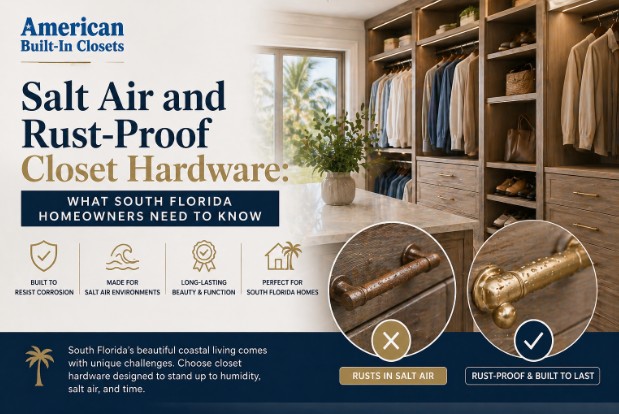
Salt Air and Rust-Proof Closet Hardware: What South Florida Homeowners Need to Know
By Perry BirmanFounder, American Built-In Closets · Custom Closet Designer, Storage Solutions Specialist & Space Optimization Expert|Originally published: May 2026
Salt air corrodes standard closet hardware faster in South Florida than in any other residential market in the continental United States, because Broward County’s coastal atmosphere carries chloride particulates that attack zinc-plated and standard steel finishes at the molecular level, regardless of whether a home sits on the Intracoastal Waterway or ten miles inland in Coral Springs.
American Built-In Closets specifies hardware grades matched to each project’s specific salt-air exposure profile at its Lauderdale Lakes manufacturing facility, so every closet system Perry Birman’s team installs carries the corrosion resistance the South Florida environment demands.
Key Takeaways
Zinc-plated hardware — the standard finish on most imported closet systems — is not rated for coastal salt-air environments and shows visible corrosion in South Florida closets within 2 to 4 years of installation, depending on proximity to the coastline and the indoor ventilation source.
Marine-grade hardware is hardware manufactured from grade 316 stainless steel or equivalent corrosion-resistant alloys, specifically formulated to resist chloride-driven oxidation in sustained coastal salt-air exposure — the correct specification for garage, laundry, and exterior-wall closet applications across Broward County.
Grade 304 stainless steel performs adequately for interior, climate-controlled bedroom and living-space closets in South Florida, where salt-air exposure is filtered through the building envelope.
The Lauderdale Lakes facility fabricates every project and selects substrate materials based on the specific room’s humidity profile and proximity to exterior walls, so each component receives a coastal-climate specification rather than a standardized national product list.
Your closet hardware is corroding right now, and you may not know it yet. American Built-In Closets specifies the right grade for every room — stop the rust with a free design consultation.
Why Does Salt Air Destroy Closet Hardware in South Florida?
Salt air destroys closet hardware in South Florida through chloride-induced corrosion — a chemical process in which chloride ions from airborne sea salt penetrate metal oxide layers, displacing oxygen and initiating an electrochemical reaction that progressively dissolves the base metal beneath the surface finish.
Standard closet hardware finishes — zinc plating, chrome plating, and painted steel — provide a barrier layer that delays chloride contact with the base metal, but none of those finishes are formulated to resist the sustained chloride concentrations present in Broward County’s coastal atmosphere.
The corrosion process accelerates in South Florida relative to other coastal regions because the combination of high ambient humidity, elevated temperatures, and salt-air particulate density creates ideal electrochemical conditions year-round rather than seasonally.
A zinc-plated shelf bracket that performs adequately in a non-coastal climate corrodes visibly within two to four years in a Fort Lauderdale closet under the same nominal indoor conditions, because South Florida’s outdoor air infiltration keeps indoor chloride concentrations elevated, even in fully air-conditioned homes.
Knowledge of why standard hardware fails in this climate matters because incorrect closet hardware choices lead to structural failure — loosened shelf pins, seized drawer slides, corroded hinge barrels — not just cosmetic discoloration, so homeowners who specify climate-appropriate hardware from the outset avoid both replacement costs and the structural risk of failed fastener connections mid-use.
What Is Marine-Grade Hardware and Why Does It Matter for South Florida Closets?
Marine-grade hardware is hardware manufactured from grade 316 stainless steel or equivalent corrosion-resistant alloys, specifically formulated to resist chloride-driven oxidation under sustained coastal salt-air exposure. The designation “marine-grade” refers to the alloy composition of the metal itself — not a surface coating or finish applied over a standard substrate.
Grade 316 stainless steel contains molybdenum as a third alloying element alongside chromium and nickel, and that molybdenum content specifically resists chloride ion penetration that grade 304 stainless steel, without molybdenum, cannot fully block under sustained coastal exposure, according to ASTM International standard A240/A240M for stainless steel plate and sheet.
The practical difference between marine-grade and standard stainless hardware in a South Florida closet is a decade or more of service life.
Grade 316 hardware installed in a Broward County garage closet performs without visible corrosion over a significantly longer service horizon than grade 304 under the same coastal conditions. Grade 304 hardware in the same location shows surface staining and, over time, pitting corrosion as chloride ions penetrate the passive oxide layer.
Zinc-plated hardware in the same location shows visible rust within two to four years and structural fastener degradation within five to seven years under sustained coastal exposure.
Marine-grade hardware is the correct specification for four closet locations in South Florida: garage storage systems, laundry room built-ins, any closet sharing a wall with a building exterior, and any closet in a home within one mile of the Intracoastal Waterway, Atlantic Ocean, or any tidal body.
The built-in closet systems American Built-In Closets installs in these locations carry grade 316 hardware as the standard specification.
If you’re ready to get
started, call us now!
Which Metals Corrode Fastest in South Florida Closets?
Standard carbon steel corrodes fastest in South Florida closets because it lacks the chromium or nickel alloying content needed to form a passive oxide barrier against chloride attack.
Carbon steel hardware — common in budget flat-pack systems and imported closet components — shows surface rust rapidly in coastal Broward County environments and develops structural corrosion that weakens fastener connections within a short period.
Zinc-plated steel corrodes at the second-fastest rate in South Florida conditions. Zinc plating sacrifices itself to protect the steel substrate beneath through a process called galvanic protection — the zinc oxidizes preferentially, delaying steel corrosion until the zinc layer is consumed.
In South Florida’s sustained chloride environment, the zinc layer on standard closet hardware is typically consumed within two to four years, after which the underlying steel corrodes at the standard carbon steel rate, so homeowners who install zinc-plated hardware accept a replacement cycle that recurs every two to five years rather than a one-time corrosion-resistant specification.
Hardware Finish
Base Metal
South FL Corrosion Risk
Recommended Application
Carbon steel (uncoated)
Carbon steel
Highest — rapid surface rust
Not recommended anywhere in South FL
Zinc-plated steel
Carbon steel
High zinc consumption within 2–4 years
Not recommended for South FL closets
Chrome-plated steel
Carbon steel
High — thin chrome layer susceptible to chloride
Not recommended for South FL closets
Powder-coated steel
Carbon steel
Moderate — fails at chips, edges, fastener holes
Interior only — not garage or laundry
Grade 304 stainless
Stainless steel
Low-Moderate — surface staining and eventual pitting
Interior climate-controlled closets only
Grade 316 stainless (marine-grade)
Stainless steel
Lowest — resists chloride long-term
All South FL closet applications
Solid brass (lacquered)
Brass alloy
Low — lacquer failure leads to cosmetic patina only
Interior decorative applications
Chrome-plated steel — common on mid-range imported closet poles, hanging rods, and decorative pulls — corrodes at a rate comparable to zinc plating in South Florida because the thin chrome layer is susceptible to microscopic pinhole penetration by chloride ions.
Powder-coated steel performs better than zinc or chrome plating because the thick polymer coating resists chloride penetration more effectively, but powder coating fails at cut edges, scratches, and fastener holes where the coating is absent, making powder-coated steel an acceptable choice only for interior closets with no direct garage or laundry room exposure.
What Hardware Should I Specify for Each Closet Type in South Florida?
Hardware specifications for South Florida closets depend on the room’s salt-air exposure category — a classification that reflects proximity to the building exterior, the ventilation source, and coastal distance rather than simply whether the home is oceanfront or inland.
American Built-In Closets classifies each project room by exposure category at the design stage, so the hardware specification the company delivers matches the actual corrosion environment the finished closet will face.
Garage storage closets require grade 316 marine-grade stainless steel hardware throughout — shelf pins, drawer slides, hinge hardware, rod brackets, and all fasteners. Garage environments in Broward County experience direct outdoor air infiltration without building-envelope filtration, resulting in the highest indoor chloride concentrations of any residential space.
No surface-coated steel hardware is appropriate for South Florida garage closet applications, regardless of price point.
Laundry room built-ins require grade 316 marine-grade stainless for all hardware in contact with water, steam, or direct ventilation airflow — drawer slides, hinge barrels, and rod brackets at a minimum. Grade 304 stainless is acceptable for decorative pulls and knobs in laundry rooms where direct moisture contact is limited.
Bedroom and living space closets in homes within one mile of tidal water require grade 316 hardware for structural components — shelf pins, drawer slides, rod brackets — and accept grade 304 for decorative hardware. Bedroom closets in inland Broward County locations beyond one mile of tidal water accept grade 304 stainless throughout.
Interior closets in high-rise buildings require grade 304 stainless as a minimum because high-rise construction in coastal South Florida circulates outdoor air through mechanical systems that concentrate salt-air particulates at higher concentrations than single-family home HVAC filtration filters.
Replacing corroded closet hardware every few years in a South Florida home is a cost most homeowners never budget for. American Built-In Closets eliminates that cycle — corrosion-proof closets start with the right specification.
If you’re ready to get
started, call us now!
How Do I Identify Corroding Hardware in an Existing South Florida Closet?
Corroding hardware in an existing South Florida closet shows identifiable signs before structural failure occurs, allowing homeowners to replace components before shelf collapse or drawer failure creates a safety or damage risk.
Surface rust streaking on shelf surfaces below metal shelf pins is the earliest visible indicator — rust from corroding shelf pins leaches into the shelf substrate, creating orange-brown staining on the shelf face within weeks of pin corrosion onset.
Drawer slides that bind, skip, or require increasing force to open indicate corrosion buildup in the slide track — corroded slide surfaces develop a microscopic scale that increases rolling resistance progressively until the slide seizes entirely.
Hinge barrels that show surface discoloration, resist spring return, or produce audible resistance on door swing indicate chloride penetration into the hinge mechanism.
Rod bracket screws that show rust streaking around the screw head indicate fastener corrosion extending into the substrate, which weakens the bracket’s load capacity before the bracket itself shows visible failure.
Cabinet door faces that rack out of square without a clear structural cause often indicate hinge barrel corrosion that has changed the hinge’s pivot geometry.
The before-and-after project gallery documents the difference between corroded legacy hardware systems and properly specified replacement installations across Broward County homes.
What Hardware Brands and Specifications Should South Florida Homeowners Request?
South Florida homeowners should request hardware specifications by alloy grade and manufacturer certification rather than by brand name, because hardware quality in the closet industry varies across brand lines without a corrosion resistance guarantee attached to the brand name alone.
The recommended specification language for a South Florida closet hardware request is: grade 316 stainless steel for all structural hardware in garage, laundry, exterior wall, and coastal proximity applications; grade 304 stainless steel for structural hardware in interior, climate-controlled bedroom applications; and solid brass or grade 304 stainless steel for decorative hardware throughout.
Blum, Grass, and Häfele manufacture drawer slides and hinge systems with stainless-steel variants suitable for coastal applications.
Requesting the manufacturer’s coastal or marine product line specifically — rather than the standard residential line — ensures that the slide and hinge hardware receives the same corrosion-resistance specification as the structural fasteners and bracket hardware.
American Built-In Closets sources hardware from manufacturers whose coastal-rated product lines carry published corrosion resistance certifications, so homeowners who work with the company receive hardware specifications that have been tested for the South Florida environment rather than assumed to perform based on general quality claims.
Review the full range of custom closet systems for Fort Lauderdale to understand how hardware specification integrates with substrate selection across all project types.
Marine-grade hardware is hardware manufactured from grade 316 stainless steel or equivalent corrosion-resistant alloys, formulated to resist chloride-driven oxidation under sustained coastal salt-air exposure. The designation refers to the alloy composition of the metal itself — not a surface coating — with molybdenum content providing chloride resistance that grade 304 stainless cannot match in sustained coastal conditions.
How long does zinc-plated closet hardware last in South Florida?
Zinc-plated closet hardware in South Florida shows visible corrosion within 2 to 4 years of installation, depending on proximity to the coastline and the presence of an indoor ventilation source. The zinc layer sacrifices itself to protect the steel substrate, but South Florida’s sustained chloride environment consumes it faster than in non-coastal climates, after which the underlying steel corrodes rapidly.
What is the difference between grade 304 and grade 316 stainless steel for closets?
Grade 316 stainless steel contains molybdenum, which specifically resists chloride-ion penetration. Grade 304 stainless lacks molybdenum and cannot fully block chloride attack under sustained coastal exposure. Grade 316 is the correct specification for garages, laundry rooms, and exterior wall closets in South Florida. Grade 304 is acceptable for interior climate-controlled bedroom closets only.
Does salt air affect closets in inland South Florida homes?
Salt air affects closets in inland South Florida homes because Broward County’s coastal atmosphere carries chloride particulates throughout the county, regardless of distance from the shoreline. Homes in inland locations, such as Coral Springs and Tamarac, experience lower chloride concentrations than oceanfront properties but still require corrosion-resistant hardware for garage and laundry closet applications.
What hardware should I use for a South Florida garage closet?
South Florida garage closets require grade 316 marine-grade stainless steel hardware throughout — shelf pins, drawer slides, hinge hardware, rod brackets, and all fasteners. Garage environments in Broward County experience direct outdoor air infiltration with no building-envelope filtration. No surface-coated steel hardware is appropriate for South Florida garage closets, regardless of price point.
How do I know if my existing closet hardware is corroding?
Existing South Florida closet hardware shows corrosion through identifiable signs: rust streaking on shelf surfaces below shelf pins, drawer slides that bind or require increasing force, hinge barrels that resist spring return or show surface discoloration, rod bracket screws with rust streaking around the screw head, and cabinet door faces that rack out of square without a clear structural cause.
Can I use powder-coated hardware in a South Florida closet?
Powder-coated steel hardware is acceptable only for interior closets in South Florida with no direct exposure to the garage or laundry room. Powder coating fails at cut edges, scratches, and fastener holes, leaving the carbon steel substrate exposed to chloride attack. Powder-coated hardware is not appropriate for garage, laundry, or exterior-wall closet applications in Broward County.
What hardware do professional South Florida closet builders specify?
Professional South Florida closet builders specify grade 316 marine-grade stainless steel for all structural hardware in garage, laundry, exterior wall, and coastal-proximity applications, and grade 304 stainless steel for structural hardware in interior, climate-controlled bedroom closets. Hardware is specified by alloy grade and manufacturer certification rather than by brand name alone.
Why does closet hardware corrode faster in South Florida than in other states?
Closet hardware corrodes faster in South Florida than in other states because the combination of high ambient humidity, elevated year-round temperatures, and sustained coastal salt-air particulate density creates ideal electrochemical corrosion conditions continuously rather than seasonally. A hardware finish that provides adequate protection in a non-coastal climate provides a significantly shorter service life under the same nominal indoor conditions in Broward County.
Founder, American Built-In Closets · Custom Closet Designer · Storage Solutions Specialist · Space Optimization Expert
Perry Birman is the founder of American Built-In Closets, a South Florida custom closet and storage company he established in 1996. With nearly three decades of experience in custom storage design, furniture manufacturing, and residential space optimization, Perry has helped homeowners throughout Miami-Dade, Broward, and Palm Beach counties create functional, customized organization systems tailored to their homes and lifestyles.
Drawing on a hands-on background in furniture manufacturing and production, Perry has extensive expertise in materials selection, fabrication processes, structural design, cabinetry construction, and custom-built storage systems. He has overseen the design, manufacturing, and installation of thousands of custom closets, garage storage systems, home offices, pantries, wall units, and built-in organization solutions throughout South Florida.
As founder of American Built-In Closets, Perry oversees design standards, manufacturing operations, product quality, and project development. His work focuses on maximizing usable space while maintaining durability, craftsmanship, functionality, and long-term value for homeowners.
Perry regularly shares insights on custom closet design, home organization, space optimization, built-in storage solutions, cabinetry construction, and residential storage trends based on nearly 30 years of real-world experience serving South Florida homeowners.
Credentials Snapshot
Founder, American Built-In Closets (1996–Present)
Nearly 30 Years of Custom Storage & Closet Design Experience
Expertise in Furniture Manufacturing & Cabinet Construction
Specialization: Custom Closets, Garage Storage, Home Offices, Pantries & Built-In Organization Systems
Service Area: Miami-Dade, Broward & Palm Beach Counties, Florida