Reach-In Closet Layout Guide Broward County: Double-Hang vs Long-Hang (How to Choose)
By Perry BirmanFounder, American Built-In Closets · Custom Closet Designer, Storage Solutions Specialist & Space Optimization Expert|Originally published: January 2026
Choosing between a double-hang and a long-hang layout in your reach-in closet affects how much you can store and how easy it feels to use every day.
Most Broward County homes have reach-in closets that are 3 to 8 feet wide. The layout you pick either works with your wardrobe or makes things awkward.
The right reach-in closet layout depends on counting your long items like dresses and coats versus your short items like folded pants and shirts, then matching that ratio to your available wall space.
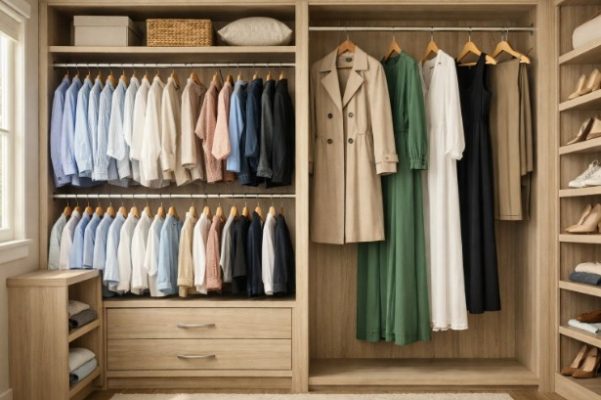
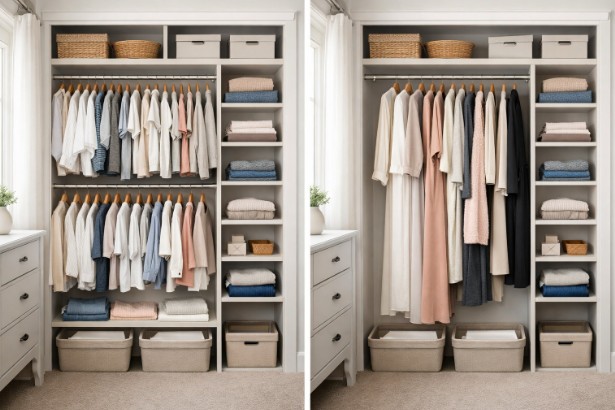
Double-hang configurations stack two rods vertically and are best suited for mostly shorter clothing.
Long-hang sections use a single rod from top to bottom, so you can hang full-length items without folding or bunching.
This guide will walk you through a simple wardrobe audit and show you how to measure your space correctly.
Key Takeaways
Match your closet layout to your wardrobe by counting long items versus short items before choosing double-hang or long-hang sections.
Measure your closet’s width, depth, and height, using standard rod clearances, so clothes hang without touching walls or doors.
Use double-hang rods for most clothing types and reserve 20 to 30 percent of rod space for long-hang items like dresses and coats.
Which Layout Holds More—And Which Works Better Day-To-Day?
Double-hang layouts typically store more clothes per square foot than long-hang layouts.
You can fit almost twice as many items when you stack two rods vertically instead of using just one tall rod.
Storage Capacity Comparison:
Layout Type
Best For
Items Per Foot
Double-hang
Shirts, folded pants, skirts
16-20 pieces
Long-hang
Dresses, coats, long pants
8-10 pieces
A U-shaped closet layout maximizes storage along three walls while keeping the center open.
This approach works well when you want to maximize vertical space in smaller reach-in closets common in Broward County homes.
Double-hang systems make daily access easier for most wardrobes. You can see your shirts on the top rod and pants on the bottom without digging through cramped spaces.
Mixing storage options, such as double-hang sections with long-hang space, gives you flexibility.
Long-hang layouts work better if you own lots of full-length items. You won’t need to fold maxi dresses or worry about coat hems dragging on lower rods.
Your closet design should match what you actually wear. Count your long items versus short items before choosing.
Most people benefit from dedicating 60-70% of their rod space to double-hang and reserving 30-40% for long-hang storage.
If you’re ready to get
started, call us now!
Step 1: Do A 5-Minute Wardrobe Audit (This Decides Everything)
Before you buy any closet components or start closet planning, figure out what you actually wear. A wardrobe audit helps evaluate your clothes and declutter so you can build a system that fits your life.
Pull everything out of your closet and sort items into three piles: wear weekly, wear occasionally, and never wear.
This process shows you the true ratio of long to short items in your wardrobe.
Count your hanging items by type:
Long-hang items: dresses, long coats, maxi skirts, robes
Your layout should match your real wardrobe, not an imagined one. The data you collect now directly affects whether a double-hang or long-hang configuration works better for your Broward County home.
Step 2: Measure The Closet The Way Designers Do (Width, Depth, Height, Doors)
You need accurate measurements before deciding between a double-hang and a long-hang layout.
Professional designers always measure four key dimensions.
Start by measuring the width of your closet from wall to wall at the back.
Use a tape measure and record this number in inches. This tells you how much horizontal space you have for rods and shelves.
Next, measure the depth of the closet from the back wall to the door opening. Keep the tape level and pulled tight.
Standard closet depth is typically 24 inches, but yours might be different. The shelf depth you can install depends on this measurement.
Measure the height from floor to ceiling to see if you have room for double hanging.
Most custom closet systems are 84 inches tall. You need at least 80 inches of height to fit two hanging rods comfortably.
Door measurements matter too.
Step inside your closet and face the door. Measure the door width, including any trim or molding.
If you have return walls (short walls beside the door frame), measure from each side wall to the door frame.
Record all measurements on paper using this format:
Width: ___ inches
Depth: ___ inches
Height: ___ inches
Door opening: ___ inches
Left return wall: ___ inches
Right return wall: ___ inches
These closet dimensions determine which layout works best for your space.
American Built-In Closets can map your reach-in in minutes and recommend the right double-hang vs long-hang split. Schedule an appointment
If you’re ready to get
started, call us now!
Standard Rod Heights And Clearances (So Your Layout Works In Real Life)
Getting your rod heights right makes the difference between a closet that works and one that wastes space.
The standard closet rod height for single-rod systems is 68 inches from the floor.
For double-hang rod setups, you need different measurements. Place your top rod at 80 to 82 inches from the floor.
Your bottom rod should sit at 40 to 42 inches high.
Allow 3 inches of space between the rod and the back wall
Your hanging storage won’t work if clothes touch the floor or crowd together.
Measure your longest items before installing anything. Add 4 to 6 inches below the hem for proper clearance.
The rod should sit 12 inches below any shelf above it. This gives you enough room to lift hangers on and off without catching on the shelf.
Leave adequate space between rods so hangers move freely and clothes don’t wrinkle against each other.
If you’re under 5’4″, consider lowering your rods by 6 to 8 inches for easier access.
Taller users above 6′ can raise rods slightly without losing function.
The Allocation Rule For Reach-Ins: How Much Long-Hang Do You Need?
Most people overestimate how much long-hang space they need. A good rule of thumb is to dedicate 20-30% of your closet to long-hang items like dresses, coats, and long pants.
Count your actual long items. Pull out anything that needs more than 50 inches of vertical space—think maxi dresses, floor-length gowns, long coats, or robes.
Here’s a simple allocation guide:
20% long-hang: Fewer than 10 long items
25% long-hang: 10-20 long items
30% long-hang: More than 20 long items or a collection of formal wear
Use the remaining 70-80% for double-hang sections for shirts, folded pants, and skirts. Double-hanging rods significantly increase storage capacity compared to a single rod.
If you’re undecided, lean toward less long-hang space. It’s easier to adjust later, and more double-hang usually means better flexibility for everyday stuff.
Think about your lifestyle, too. If you work from home, you probably need less formal long-hang space. If you attend many events, increase the long-haul by 5-10%.
Measure your longest items before you finalize your closet. Some reach-ins work better with specialized layouts tailored to what you actually wear or collect.
Layout Options That Work In Most Reach-In Closets
Most reach-in closets in Broward County work best with one of three layouts. Each one balances hanging space differently, depending on your wardrobe and the amount of vertical space you have.
Option A: Mostly Double-Hang (Capacity-First)
This layout stacks two rods on most of your closet wall. You get about 70-80% of your closet for double-hang sections, with just a small spot for long items.
Best for:
Wardrobes full of shirts, blouses, and folded pants
Professional attire with a few dresses
Shared closets where both people wear mostly short garments
Small closets needing max capacity
The top rod is 80-84 inches high, and the bottom one is 40-42 inches. That gives enough clearance so shirts and jackets don’t overlap. Custom storage systems with this setup can double or triple what you can hang.
Add adjustable shelves above the double-hang for bags, bins, or off-season stuff. If you have any dresses or coats, keep 3-4 linear feet for long-hang items.
Option B: Mostly Long-Hang (Specialty-First)
This style uses 60-70% of your wall space with a single rod at 65-70 inches high. You only get a small section for double-hang.
Works well when:
You own lots of long dresses, gowns, or formal wear
Your wardrobe has long coats or robes
You prefer hanging pants full-length
You store most short items elsewhere
The downside: you waste vertical space above shorter clothes. You can add a 40-inch shelf, but reaching between hanging clothes isn’t always practical.
Try adding custom cabinetry with drawers at the bottom of your long-hang. That way, you get some capacity back without messing up your hanging space.
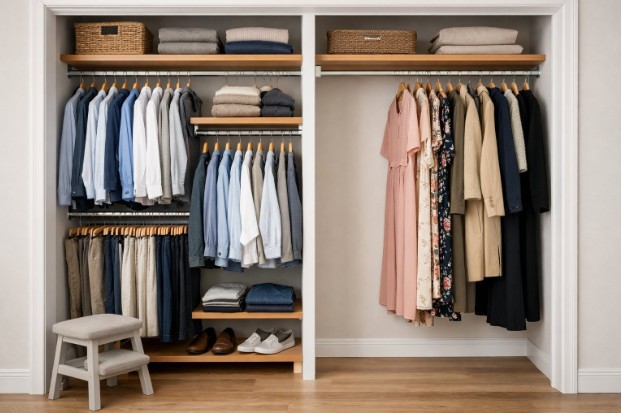
The split layout allocates about two-thirds of your closet to double-hang rods and one-third to long-hang rods. This setup fits most wardrobes without sacrificing either type.
Layout specifics:
Put long-hang on one end (usually 24-36 inches wide)
Fill the rest with double-hang
Add shelves above both spots
Use closet storage bins or drawers under the double-hang
This way, you’ve got room for 4-6 dresses or long coats and can still hang 30-40 shirts and jackets. Most closet systems allow you to adjust shelves and rods, so you can adjust them as your needs change.
If you own 8-10 long items, make the long-hang section 36-40 inches wide. Only have a couple of dresses? Shrink it to 18-24 inches.
If you’re ready to get
started, call us now!
Common Mistakes That Make Either Layout Fail
Poor planning can ruin even the best closet. Measure your clothes before placing them on rods or shelves.
Not Using Vertical Space
Many people just waste the space above their hanging clothes. Double-hang rods use the space better, and you can add shelves near the ceiling for items you rarely use.
Wrong Rod Heights
If you install rods at the wrong height, you lose space. Short-hang rods should be 40-42 inches from the floor for pants and shirts. Long-hang rods need 60-68 inches for dresses and coats.
Ignoring Your Actual Wardrobe
You can’t pick a layout if you don’t know what you own. Count your long and short items. If you have 10 dresses but 50 shirts, a full-length hanging wastes space.
Forgetting About Depth
Standard closet depth is 24 inches, but hangers need at least 2 inches of clearance. If shelves are too deep, items get lost and are hard to reach.
Not Planning for Shared Spaces
Couples should split the closet down the center for equal space. Sharing rods without a plan just leads to chaos.
Skipping Quality Hardware
Cheap rods bend, and brackets pull out of the wall. Use hardware that actually holds the weight of your clothes, not just what looks good at first.
What We Recommend at American Built-In Closets
At American Built-In Closets, every reach-in closet makeover starts the same way: we look at what you actually wear and how you use the space day-to-day.
Before you choose double-hang or long-hang, do a quick wardrobe inventory—because the right layout is determined by your clothing mix, not a generic template.
Our core design principles for reach-in closets:
Use double-hang for ~70% of the layout when your wardrobe is mostly shirts, blouses, folded pants, skirts, and short jackets.
Reserve ~20–30% for long-hang so you still have dedicated space for dresses, coats, and full-length garments.
Add adjustable shelving above hanging zones for items you don’t need daily—seasonal bins, extra linens, and overflow storage.
Include pull-out drawers or baskets at an ergonomic height to keep accessories and folded items visible, organized, and easy to reach.
Plan around proper reach-in depth. A typical target depth is 24 inches, which prevents hangers from crowding the back wall and keeps garments from bunching.
Install double-hang rods at proven heights: approximately 40 inches and 80 inches from the floor to maximize vertical capacity for most adults.
Protect clearance for long-hang. If you own floor-length items, plan for at least 66 inches of vertical clearance in your long-hang zone.
Quick measurements guide (vertical space planning):
Item Type
Vertical Space Needed
Shirts / Blouses
Pants (folded)
~36 inches
Dresses
~60–72 inches
Coats
~48–52 inches
Finally, we design around your routine—not just the closet. If you dress formally for work, you’ll typically benefit from more long-lasting suits, dresses, and outerwear.
If your wardrobe is mostly casual, a double-hang-heavy layout paired with more drawers and shelves usually delivers the best everyday convenience.
What Clients Say About American Built-In Closets
Every project we complete—whether it’s a master suite upgrade or a simple reach-in reconfiguration—ends with homeowners who appreciate design precision, punctual installation, and long-term reliability.
Here’s what our clients are saying:
Niki Velarde
★★★★★ “Perry came and designed our closet and gave us an estimate. He was very professional and friendly. Also very helpful. The guys who came by to install it were also very professional and efficient. It was done in a few hours, and they were very nice. Overall, a great experience, I highly recommend!”
Bonnie Weberman
★★★★★ American Built-In Closets provides high-quality products and outstanding long-term customer service. We had a problem six years after installation, and were provided repair service at no cost. Perry said, ‘That never should have happened.’ It is truly rare to find a business that stands behind its product over the long term. I highly recommend American Built-In Closet.”
B. Weberman
★★★★★ We used American Built-In Closets to install numerous closets in our home over six years ago. We recently had two issues that needed repair. Perry set a date for the repair. When I asked him what the charge would be, his answer was, ‘That never should have happened. There is no charge.’ That comment speaks to the quality and ethic behind the company. The workers are respectful, prompt, and neat. The end product—perfection! I highly recommend the company.”
Maryann Welsh — October 22, 2025
★★★★★ “Perry and his team are wonderful! I have had my closets done in four homes and will only use ABC. Beautiful, functional, and exactly what we needed each time. Thank you, Perry, for sharing your expertise and having an amazing crew of installers. My highest recommendation and gratitude!”
Beth M — July 1, 2025
★★★★★ “Perry and his team did a fantastic job! Our closets make great use of the space and are simple and elegant! Highly recommend.”
Get a reach-in layout that fits your clothing mix, door style, and daily routine—designed, built, and installed by American Built-In Closets. Schedule an appointment
Contact Us Today For An Appointment
Frequently Asked Questions
Is double-hang or long-hang better for a reach-in closet?
Double-hang usually wins out in reach-in closets because it doubles the short-hang capacity for shirts, blouses, and folded pants. Long hanging is better only if you own many dresses or coats. Most homes do best with a hybrid layout.
How much long-hang space do I need in a reach-in closet?
Plan long-hang based on your wardrobe, not guesses. A common reach-in standard is 15% long-hang and 85% double-hang; adjust as needed for frequent dresses, coats, or uniforms that must hang full-length.
What are standard double-hang rod heights?
Typical double-hang placement places the upper rod at approximately 80–82 inches from the floor and the lower rod at approximately 40 inches. This creates two usable short-hang zones that fit most adults and maximizes vertical space in reach-ins.
What’s the minimum closet depth for hanging clothes properly?
Most hanging sections work best at about 24 inches of closet depth, so hangers and sleeves don’t press into the back wall. Shallower closets can work, but you may need slimmer hangers or a different layout to prevent bunching.
When should I choose long-hang in a reach-in closet?
Use long-hang when garments need full vertical clearance—formal dresses, coats, and long outerwear. Many guides recommend placing long-hang rods at mid- to upper 60 inches from the floor, and AB notes 66 inches of clearance for full-length items.
Can I mix double-hang and long-hang in the same reach-in closet?
Yes. A practical reach-in layout is double-hang on one side and a long-hang or single-hang zone plus a narrow tower on the other. Add adjustable shelves high up for infrequently used items and drawers at waist height for daily accessories.
How do sliding doors affect reach-in closet layout choices?
Sliding doors limit access to the far left and right edges, so prioritize the most-used hanging zones in the center and use towers/drawers where doors don’t block them. Double-hanging often increases capacity without requiring deeper construction changes.
Founder, American Built-In Closets · Custom Closet Designer · Storage Solutions Specialist · Space Optimization Expert
Perry Birman is the founder of American Built-In Closets, a South Florida custom closet and storage company he established in 1996. With nearly three decades of experience in custom storage design, furniture manufacturing, and residential space optimization, Perry has helped homeowners throughout Miami-Dade, Broward, and Palm Beach counties create functional, customized organization systems tailored to their homes and lifestyles.
Drawing on a hands-on background in furniture manufacturing and production, Perry has extensive expertise in materials selection, fabrication processes, structural design, cabinetry construction, and custom-built storage systems. He has overseen the design, manufacturing, and installation of thousands of custom closets, garage storage systems, home offices, pantries, wall units, and built-in organization solutions throughout South Florida.
As founder of American Built-In Closets, Perry oversees design standards, manufacturing operations, product quality, and project development. His work focuses on maximizing usable space while maintaining durability, craftsmanship, functionality, and long-term value for homeowners.
Perry regularly shares insights on custom closet design, home organization, space optimization, built-in storage solutions, cabinetry construction, and residential storage trends based on nearly 30 years of real-world experience serving South Florida homeowners.
Credentials Snapshot
Founder, American Built-In Closets (1996–Present)
Nearly 30 Years of Custom Storage & Closet Design Experience
Expertise in Furniture Manufacturing & Cabinet Construction
Specialization: Custom Closets, Garage Storage, Home Offices, Pantries & Built-In Organization Systems
Service Area: Miami-Dade, Broward & Palm Beach Counties, Florida