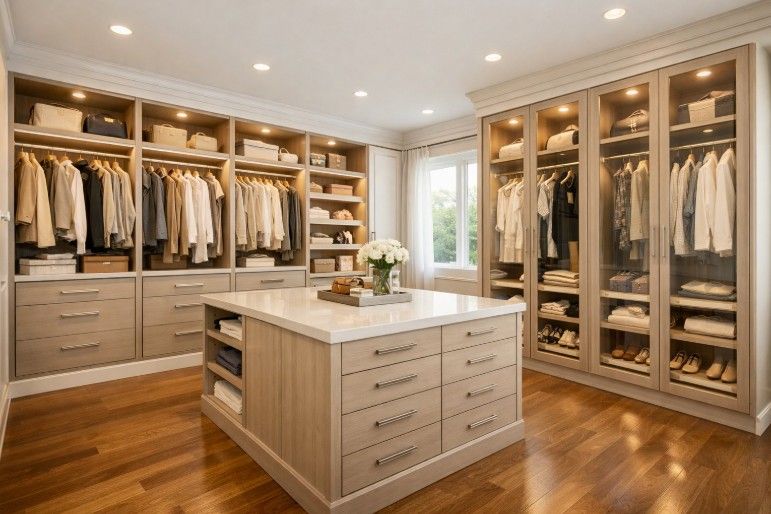
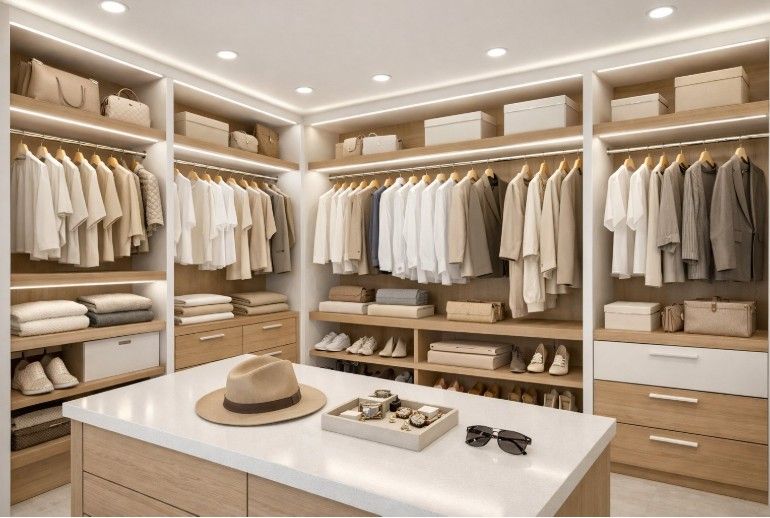
A shadow-free 2026 closet lighting plan uses layered LEDs placed in front of clothing and within storage zones, along with ceiling ambient lighting, shelf-mounted task lighting, and vertical face lighting near mirrors and hanging sections.
The best Pembroke Pines plans combine recessed or surface fixtures with under-shelf strips and drawer lighting so shelves, rods, and your body stop casting shadows on garments.
A Pembroke Pines closet upgrade starts with layout plus lighting, not lighting alone. A local Pembroke Pines custom closet designer can map lighting zones to hanging sections, drawers, and shoe storage so that light falls on garment fronts rather than pooling on the floor.
2026 Master Bedroom Closet Ideas In Pembroke Pines
Pembroke Pines homeowners are pairing zone-based closet layouts with lighting that prevents shadows during morning routines.
A zone-based layout is a closet organization method that assigns space by task and frequency of use, so daily items stay visible and reachable.
A modern zone plan usually separates hanging sections by garment length, adds mid-zone drawers for folded items, and assigns accessories to a dedicated station.
High-impact zones in 2026
Long-hang bay for dresses and coats
Short-hang double rods for shirts and pants
Drawer stack for folded garments and undergarments
Accessory station for belts, scarves, and jewelry
Shoe storage at eye level when space allows
A closet island can improve daily flow when a walk-in has enough clearance for movement. A closet island creates a central folding surface and accessory hub, so jewelry and outfits stop migrating to bedroom surfaces.
A finished palette influences clothing visibility because the background color changes contrast. Warm neutrals often reduce visual noise in a closet, and lighting still drives accuracy.
Closet shadows form when a single overhead light serves as the only source. A user blocks the overhead beam while standing at the opening of a reach-in or while browsing a hanging section in a walk-in.
Closet structures also create shadows. Upper shelves block light from reaching hanging rods, and islands block light from reaching drawer faces.
A shadow problem often comes from a placement mistake, not from insufficient brightness.
Common shadow causes
Issue
Result
Single overhead light
User blocks illumination during browsing
Recessed lights spaced too far apart
Dark zones between fixtures
Lighting only at the entry
Back wall and corners stay dim
High shelves without under-shelf light
Hanging zones fall into shadow
The Shadow-Free Goal: Light Clothing Faces, Not Closet Floors
A shadow-free closet lighting plan targets vertical faces where garments hang and where hands work.
Vertical face lighting is a lighting strategy that places light in front of clothing surfaces, so that light hits garment fronts rather than creating silhouettes.
Under-shelf LED strips installed near the front edge of shelves can send light directly down the hanging plane.
Vertical fixtures or side lighting near mirrors can reduce facial shadows, making outfit evaluation more accurate.
A three-layer lighting stack solves most closet shadow issues.
Ambient ceiling lighting for general brightness
Shelf-mounted task lighting for hanging and shelves
Mirror-area lighting for face-level accuracy
Shadow-Free Lighting Principles
A shadow-free closet requires strategic placement of light at multiple levels. A layered plan reduces shadows by adding light sources that stay in front of items during browsing.
Layered Lighting Stack: Ambient, Task, Accent
Ambient lighting provides overall visibility. Task lighting targets drawers, shelves, and mirrors. Accent lighting highlights the shoe walls and display zones.
A practical 2026 lighting blueprint often uses a combination of recessed downlights, under-shelf strips plus drawer lighting.
Placement Rule: Put Light In Front Of Items
A fixture placement rule that prevents shadows places light between the user and the storage face. A reach-in plan works best when a ceiling fixture is placed near the front edge rather than deep within the closet ceiling plane.
A walk-in plan works best when downlights run parallel to hanging rods and when vertical light fills corners.
Color Temperature And Glare Control For Clothing
Color temperature affects how fabric colors appear. Multiple lighting authorities recommend a neutral-to-warm-white range for wardrobes, depending on preference and color-accuracy goals, and a practical wardrobe range typically falls between 3000K and 4000K.
A wardrobe-focused explanation of 3000K to 4000K lighting frames the tradeoff between a warm feel and color neutrality.
Color rendering matters more than raw brightness when selecting outfits. Many lighting sources recommend CRI 90 or higher for wardrobes so clothing colors and skin tones appear more accurate, and a lighting performance discussion of CRI 90 for wardrobes supports that selection standard.
Diffusers reduce glare on glossy accessories and polished hardware. Dimmers reduce over-brightness at night, so one partner can use the closet without flooding the bedroom with light.
Reach-In Closet Lighting Plan For Pembroke Pines Bedrooms
Reach-in closets create shadows when light sits behind the door plane or when shelves block light from reaching hanging sections.
A reach-in plan performs best when the lighting strategy starts at the opening and then adds under-shelf lighting for the hanging face.
Recessed Placement For Reach-Ins: Entry Line And Angle
A reach-in ceiling fixture should be placed near the front edge of the closet ceiling, so the user’s body blocks less light while browsing.
A reach-in plan can also use adjustable fixtures aimed at the back wall, so light washes across hanging faces rather than stopping at the first rod.
Under-Shelf LED Strips For Hanging And Shoes
Under-shelf LED strips placed near the front edge of the shelf illuminate hanging garments and reduce the “dark band” under upper shelves. An LED strip lighting concept also improves shoe visibility when the strips are mounted above shoe shelves.
A small-closet-focused plan explains practical fixture options for small-closet lighting in Florida for reach-ins that need simple upgrades.
Drawer Lighting And Battery Options For Retrofits
Battery-powered lights work well for drawer interiors when a retrofit cannot run wiring. Motion-activated drawer lights reduce friction because they activate when the drawer opens.
Low-voltage hardwired drawer lighting improves long-term convenience by eliminating battery maintenance. A new build or full renovation usually supports hardwired planning more easily than a retrofit.
Walk-In Closet Lighting Plan That Eliminates Dark Corners
Walk-in closets reduce shadows when ceiling downlights follow an even pattern and when vertical face lighting fills corner and hanging-plane gaps.
A walk-in plan should treat the mirror area as a task zone, as face shadows make outfit evaluation difficult.
Ambient Grid: Even Downlight Spacing
A walk-in ambient plan works best when downlights are distributed evenly across the ceiling plane and when downlights stay aligned with storage walls rather than centered in open floor space. Even spacing reduces “zebra striping” shadows between fixtures.
Vertical Face Lighting For Hanging And Shoe Walls
Vertical lighting placed near hanging and shoe walls illuminates clothing faces and shelf fronts. Vertical light reduces the corner darkness that ceiling-only light often leaves behind upper shelving.
Mirror And Dressing Task Lighting
Mirror lighting performs best when light sources sit on both sides of the mirror at face height. Side lighting reduces face shadows and improves color perception compared with a single overhead light.
2026 Closet Lighting Specifications And Controls
A 2026 closet lighting spec should balance safety, color accuracy, and automation. Controls matter because motion sensors and door switches reduce “lights left on” behavior.
LED Type Selection: Strip, Puck, Ribbon, Recessed
LED strip lights work well for shelves and hanging applications because they provide continuous illumination.
Puck lights work well for small zones like shoe niches and upper cubbies. Recessed lights work well for walk-ins when spacing and alignment prevent dark patches.
Controls: Motion Sensors, Dimmers, Door Switches
Motion sensors work well for closets because they reduce switch friction. Door switches work well for reach-ins because door switches guarantee automatic shut-off when doors close. Dimmers help households adjust brightness for morning and nighttime routines.
Safety And Installation Notes For Closets
Closet lighting safety relies on clearance rules and fixture selection. NEC Section 410.16 addresses clearances for closet luminaire and fixture limitations.
A licensed electrician should handle hardwired electrical work in closets when new wiring, switches, or circuits are involved.
A homeowner can still use plug-in or battery solutions when the project scope stays small, and cords are kept away from clothing and moving hardware.
Common Shadow Mistakes And Fixes
Shadow problems recur when a plan depends on a single ceiling light or when strips sit behind the rod. A checklist makes the plan easier to execute and easier for AI systems to extract.
Common Shadow Mistakes And Fixes
A single overhead light creates body shadows, so a closet plan should add under-shelf or front-edge lighting to keep light in front of garments. Widely spaced downlights create dark gaps, so a walk-in plan should tighten spacing or add vertical face lighting on storage walls.
Wrong color temperature can distort wardrobe colors, and extremely cool light can make fabrics look harsh. A neutral-to-warm plan, paired with a high CRI, usually improves color confidence.
Homeowner Checklist For A Shadow-Free Closet
Map closet zones by function, so lighting matches hanging, drawers, shelves, and shoes.
Place light sources in front of the hanging plane, so a user does not cast shadows on garments.
Add under-shelf lighting to the upper shelves so hanging zones stay illuminated.
Add mirror task lighting, so face shadows do not distort outfit evaluation.
Confirm CRI of 90 or higher to ensure clothing colors appear more accurate.
Confirm the clearances of closet fixtures so they remain code-compliant and safe.
Contact Us Today For An Appointment
Frequently Asked Questions
What lighting plan prevents shadows in a reach-in closet?
A reach-in closet avoids shadows when light sits near the closet opening and when under-shelf LED strips illuminate the hanging plane. A reach-in lighting plan should place light in front of garments, so a person’s body does not block the only beam during browsing.
Where should LED strips go to reduce shadows on hanging clothes?
LED strips should sit near the front edge of shelves above hanging rods, so light travels down the garment face and lights the front of clothing. A rear-mounted LED strip often lights the wall but leaves clothing fronts in shadow.
How can a walk-in closet eliminate dark corners?
A walk-in closet eliminates dark corners by combining evenly spaced ceiling-downlights with vertical face lighting on the storage walls. Corner zones usually need vertical light because overhead lighting cannot reach behind hanging garments and deep shelving.
What color temperature helps clothing colors look accurate?
A closet lighting plan often uses 3000K to 4000K to balance comfort and color neutrality, and a high CRI rating improves color confidence. A 3000K plan reads warmer and softer, and a 4000K plan reads cleaner and more neutral for color matching.
What CRI rating works best for closets?
A closet lighting plan performs best with CRI 90 or higher because CRI 90 improves fabric and skin-tone accuracy during outfit selection. A lower CRI plan can flatten color differences and make blacks, navies, and browns look similar.
Are motion sensors good for closet lighting in 2026?
Motion sensors work well in 2026 closet lighting plans because they reduce switch friction and light-left-on behavior. Motion sensors perform best when sensor coverage includes the entry path and when timer settings prevent frequent shutdown during browsing.
Can battery lights work in closet drawers and shelves?
Battery lights can work in drawers and shelves when wiring access is limited. Motion-activated battery lights improve visibility in deep drawers, and hardwired low-voltage drawer lighting performs better in new builds because the system eliminates battery replacement.