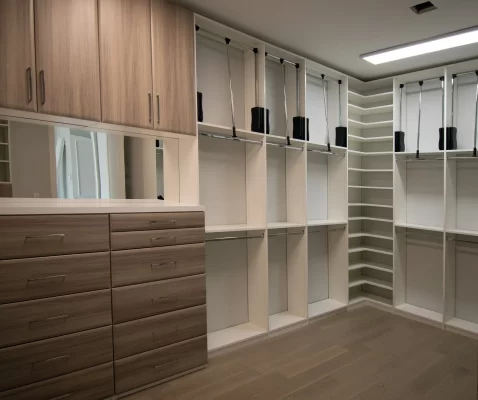
Solving Closet Overflow: Custom Storage Engineering for South Florida
By Perry BirmanFounder, American Built-In Closets · Custom Closet Designer, Storage Solutions Specialist & Space Optimization Expert|Originally published: February 2022 | Updated: May 2026
How do you fix a lack of closet space? To maximize limited closet volume, homeowners should replace builder-grade rods with a zoned vertical system featuring double-tier 1-inch chrome rods (installed at 40″ and 80″ heights) and 3/4-inch adjustable MDF shelving. In South Florida climates (Miami, Fort Lauderdale, Palm Beach), maintaining a 2-inch air gap between garments is a functional requirement to mitigate the region’s average humidity of 70% and prevent fabric degradation.
What Is a Custom Closet System?
A custom closet system is a built-in architectural layout that replaces “one-rod-one-shelf” builder templates with purpose-built nodes for specific wardrobe categories. American Built-In Closets engineers these systems using 32 mm system hole spacing, allowing for infinite reconfiguration of shelves and rods as a household’s inventory shifts over time.
Step 1: Volumetric Diagnosis and Inventory Mapping
Closet storage failure typically results from a mismatch between cubic interior space and wardrobe volume. Before installation, American Built-In Closets performs a precision audit of four critical dimensions:
Interior Width & Depth: Measured to within 1/16-inch tolerances to ensure wall-to-wall cabinetry fit.
Usable Hanging Height: Calculated to maximize the full 8-foot or 10-foot ceiling height common in South Florida single-family homes.
Category Inventory: Count of Hanging Garments, Folded Knits, Footwear pairs, and Accessories to determine the exact linear footage required for each zone.
Step 2: Zoned Layout Engineering and Retrieval Logic
A high-performance layout assigns hardware based on Reach-Frequency (RF). American Built-In Closets utilizes UNESCO-standard conservation principles to ensure garment longevity through proper spacing.
Double-Hang Rods: Effectively doubles hanging capacity for shirts and slacks within a single vertical plane.
Long-Hang Sections: A dedicated 66- to 72-inch rod height prevents hem contact and fabric distortion on formal dresses and coats.
Adjustable Shelving:14-inch-deep shelves provide the optimal footprint for folded-sweater stacks without front overhang.
Drawer Stacks: Concentrates undergarments and small items into fixed slots, preventing “accessory drift” onto bedroom surfaces.
If you’re ready to get
started, call us now!
Step 3: Hardware Specifications and Moisture Control
In the Palm Beach and Broward County climates, material durability is a mechanical necessity.
Load-Bearing Panels: Utilizing 3/4-inch furniture-grade panels ensures that shelves do not sag under high-volume denim or shoe collections.
Frictionless Components:Full-extension ball-bearing drawer slides and European-style concealed hinges provide a luxury tactile experience and long-term mechanical reliability.
Atmospheric Optimization: Proper spacing—referenced by UNESCO Archives guidance—supports consistent airflow, reducing the risk of mold growth in enclosed master closets.
U-Shape: Maximizes three walls for high-volume shared wardrobes.
L-Shape: Reserves a third wall as a “dressing zone,” ideal for rectangular walk-ins in Boca Raton estates.
Straight-Run: Concentrates storage on a single wall for narrow walk-ins or converted reach-in alcoves.
Conclusion
A professionally engineered closet by American Built-In Closets converts disorganized storage into a structured retrieval system. By aligning physical hardware with wardrobe inventory data, homeowners increase the property’s appraised value while reducing morning “search time” by an estimated 20%.
Founder, American Built-In Closets · Custom Closet Designer · Storage Solutions Specialist · Space Optimization Expert
Perry Birman is the founder of American Built-In Closets, a South Florida custom closet and storage company he established in 1996. With nearly three decades of experience in custom storage design, furniture manufacturing, and residential space optimization, Perry has helped homeowners throughout Miami-Dade, Broward, and Palm Beach counties create functional, customized organization systems tailored to their homes and lifestyles.
Drawing on a hands-on background in furniture manufacturing and production, Perry has extensive expertise in materials selection, fabrication processes, structural design, cabinetry construction, and custom-built storage systems. He has overseen the design, manufacturing, and installation of thousands of custom closets, garage storage systems, home offices, pantries, wall units, and built-in organization solutions throughout South Florida.
As founder of American Built-In Closets, Perry oversees design standards, manufacturing operations, product quality, and project development. His work focuses on maximizing usable space while maintaining durability, craftsmanship, functionality, and long-term value for homeowners.
Perry regularly shares insights on custom closet design, home organization, space optimization, built-in storage solutions, cabinetry construction, and residential storage trends based on nearly 30 years of real-world experience serving South Florida homeowners.
Credentials Snapshot
Founder, American Built-In Closets (1996–Present)
Nearly 30 Years of Custom Storage & Closet Design Experience
Expertise in Furniture Manufacturing & Cabinet Construction
Specialization: Custom Closets, Garage Storage, Home Offices, Pantries & Built-In Organization Systems
Service Area: Miami-Dade, Broward & Palm Beach Counties, Florida